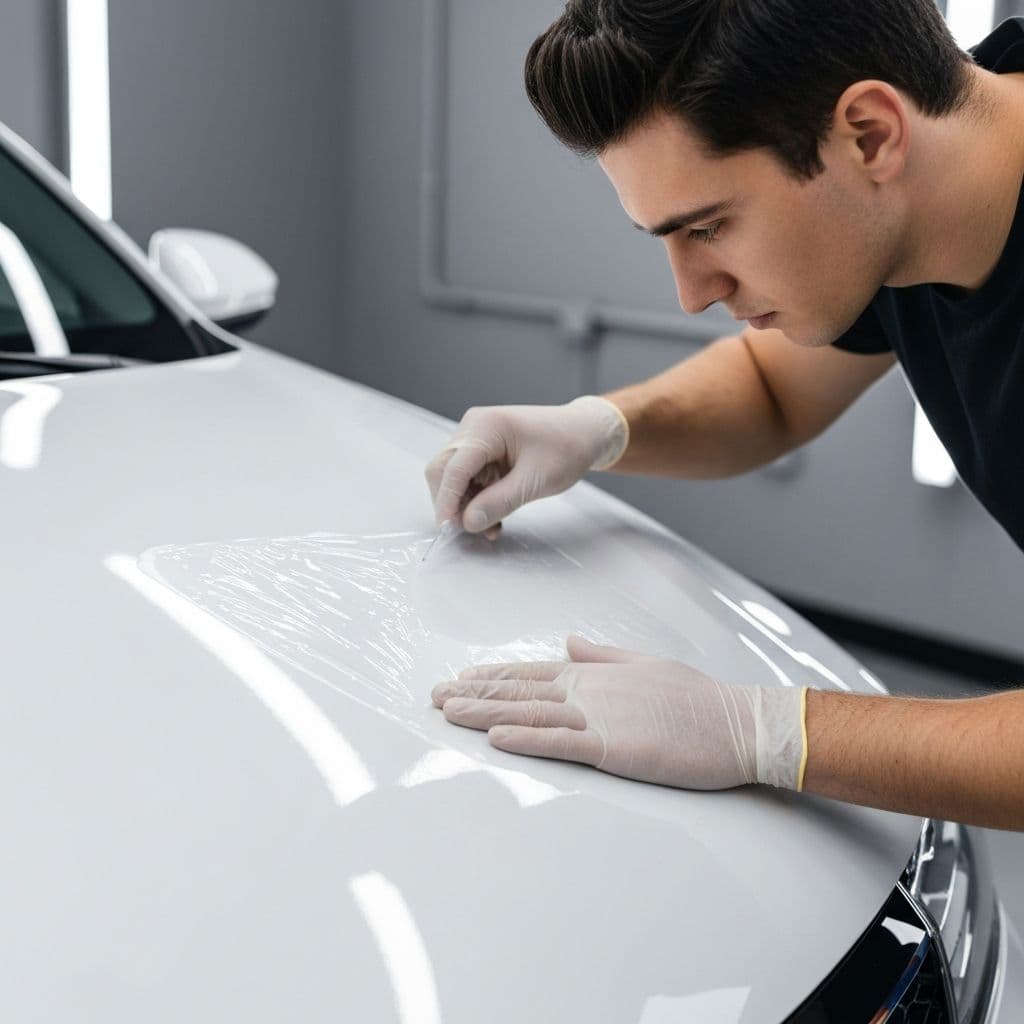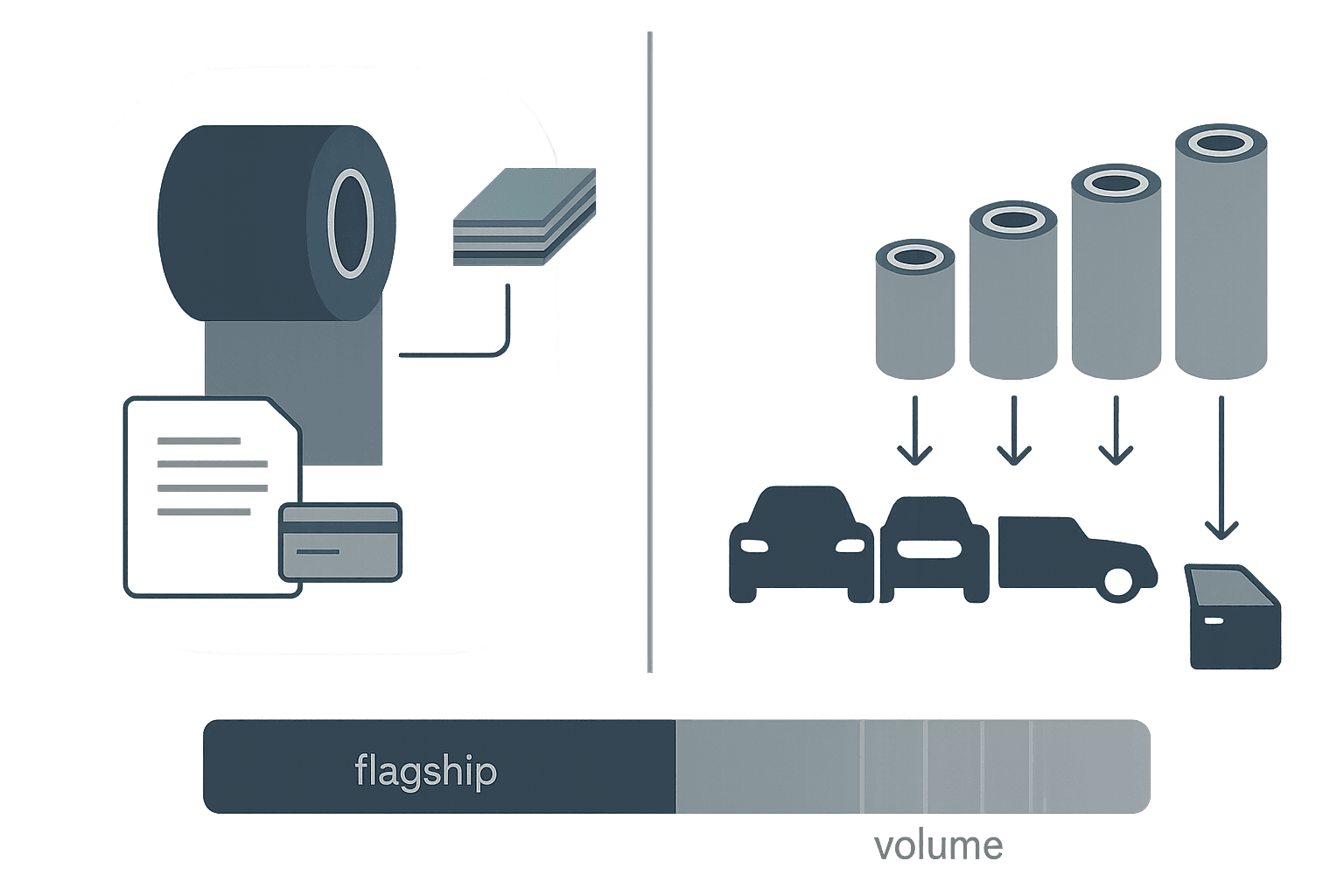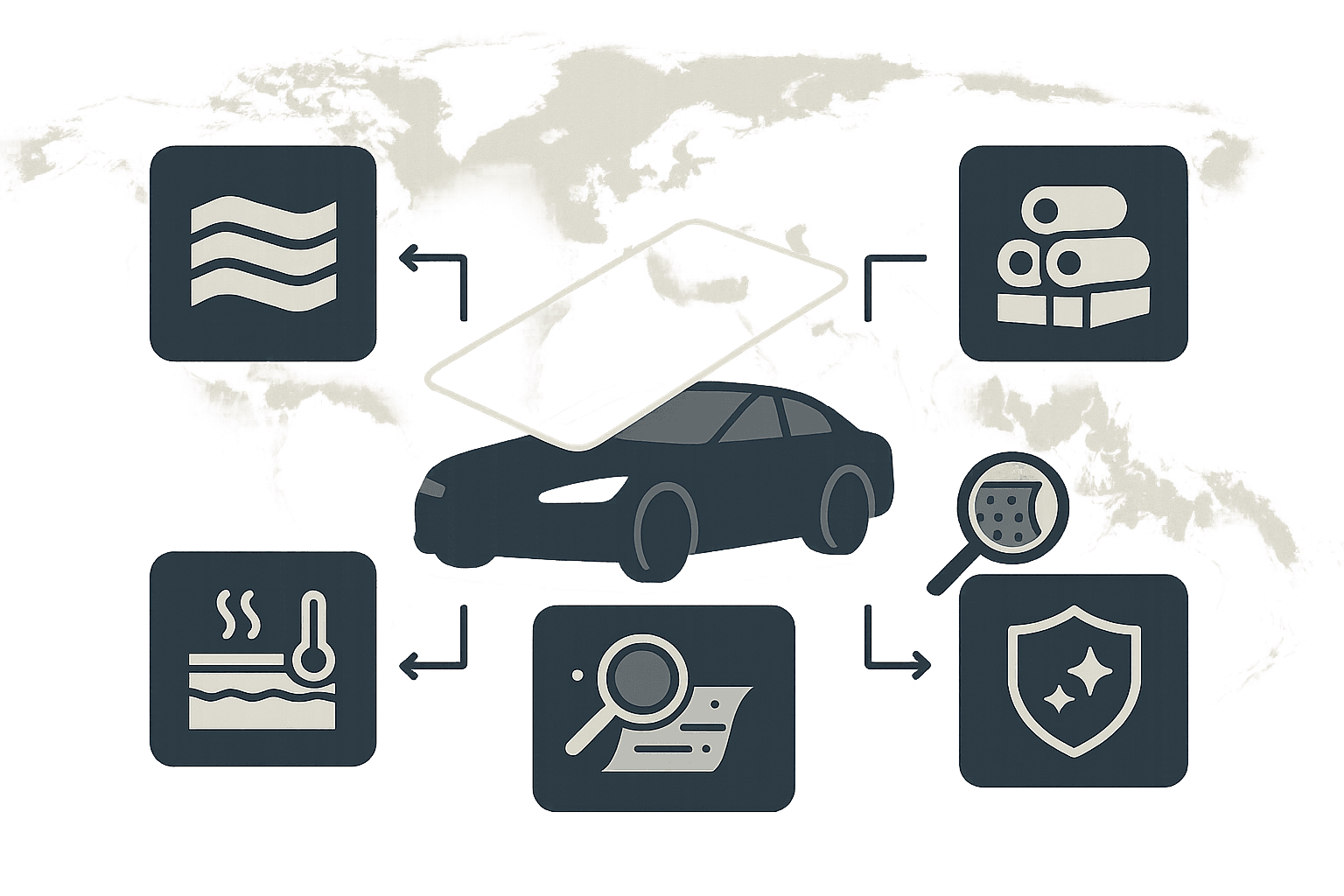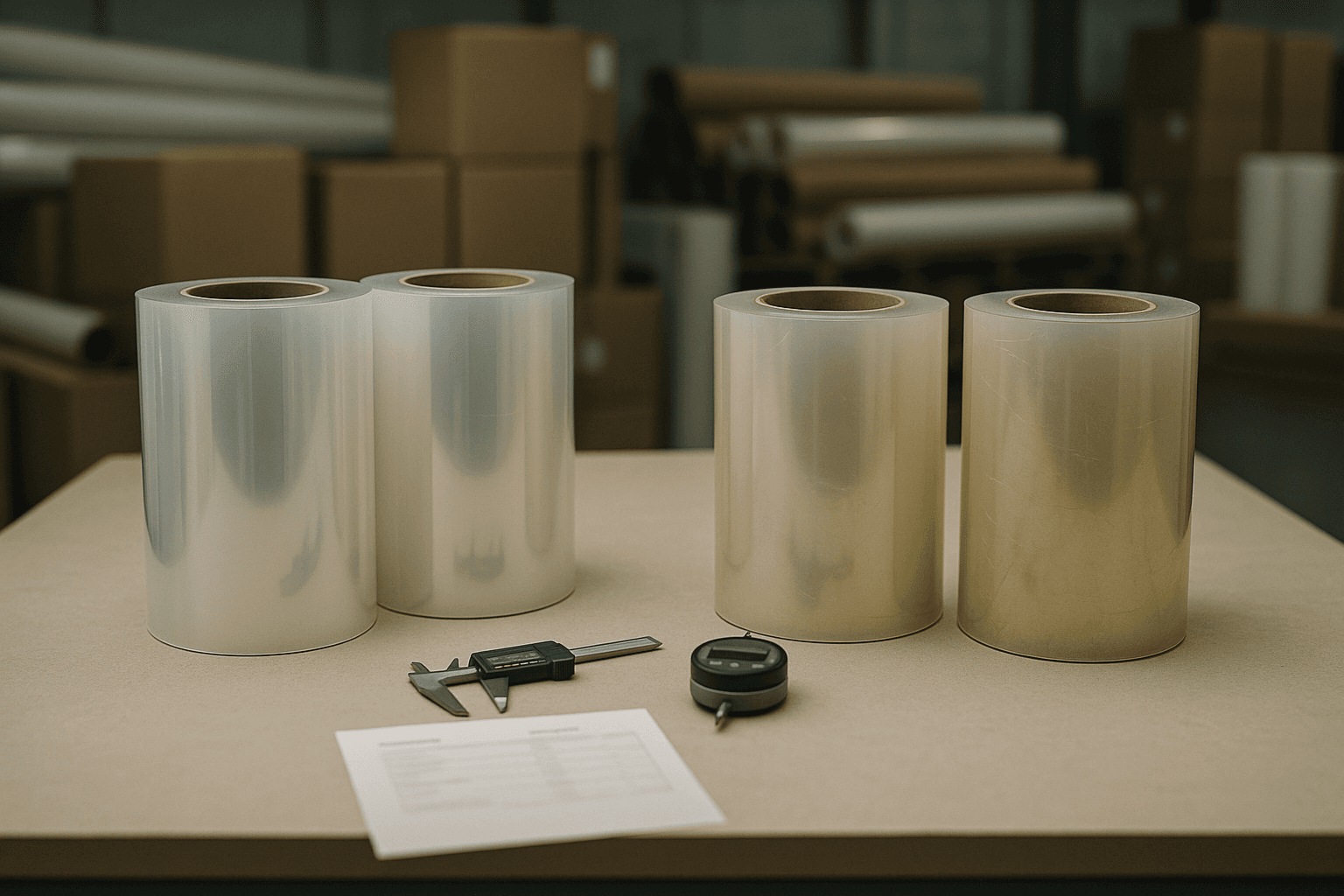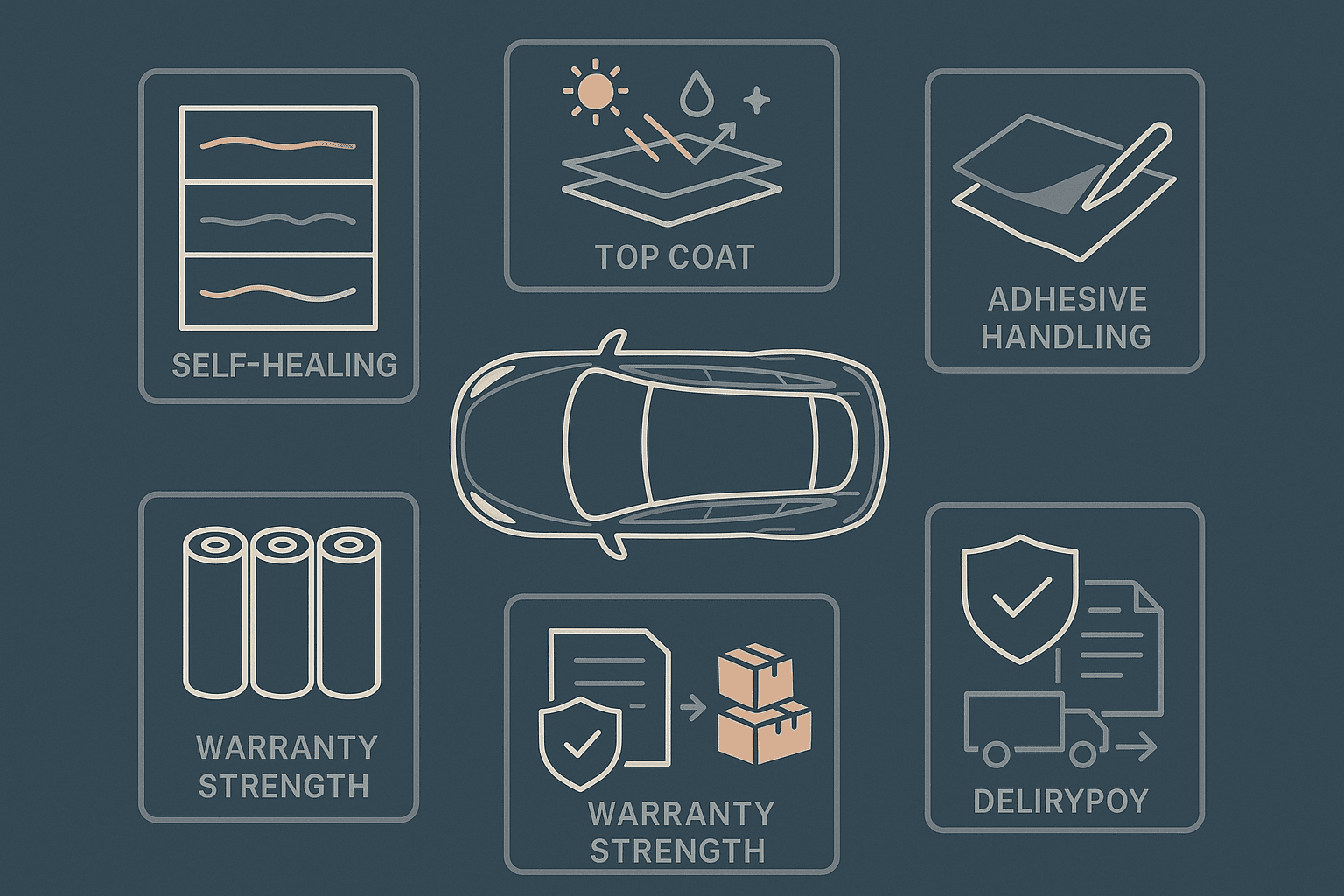
Paint protection film for a Tesla Model Y is not just about picking “XPEL or something else.” For distributors, installers, OEM buyers, and private label teams, the real work is specifying a film system—self-healing, top coat, adhesive, and repeatability—so that high-volume Model Y jobs run consistently and profitably.
1. What this guide covers for Tesla Model Y PPF demand
This guide uses XPEL-style clear PPF demand on Tesla Model Y as a reference point and explains how to:
- Translate that demand into stocking and product-line decisions.
- Evaluate self-healing, top coat, and adhesive behavior in a technical way.
- Compare major PPF brands and alternatives without unsafe equivalence claims.
- Build a verification plan: spec sheets, sample tests, and supplier qualification.
The focus is clear paint protection film for external body panels. Color and matte PPF are relevant mainly for range planning, and OEM/private label programs are treated as procurement paths rather than separate technologies.
This is not a DIY installation tutorial; it is workflow and stocking guidance for professional teams that see the Tesla Model Y as a high-frequency PPF platform.[5]
2. What buyers are really comparing when they ask about XPEL PPF for Tesla Model Y
When technical buyers mention “XPEL PPF Tesla Model Y”, they are usually using XPEL as a performance and perception benchmark, not necessarily locking into a single brand. In practice, most premium PPF programs from well-known manufacturers share some core attributes such as TPU construction, self-healing top coats, and long-term warranties.[2]
For a high-volume vehicle like the Model Y, the practical comparison framework looks more like this:
- Self-healing response – How quickly and under what conditions light marring recovers.
- Top-coat durability – Gloss or matte consistency, stain resistance, and wash behavior over time.
- Adhesive behavior – Tack, repositionability, edge holding, and sensitivity to install fluid.
- Batch consistency – Whether every roll behaves like the test sample.
- Repeat supply – Lead times, packaging, and the ability to replenish without spec drift.
At an awareness stage, the most productive next action is not to rewrite your price sheet around a new logo, but to run structured sample tests and begin a supplier-qualification process.
3. Self-healing: how to evaluate the claim correctly
3.1 What “self-healing” actually means
In modern PPF, self-healing is usually achieved by a TPU (thermoplastic polyurethane) layer with an engineered top coat that can flow at modest temperatures, relaxing light surface defects.[1][3]
A typical technical description from a major manufacturer notes that the film uses a polyurethane construction with a clearcoat and that it has “self-healing technology to remove minor scratches or marks with heat applied to the film surface.”[1] That wording is important: it explicitly limits healing to minor marks and requires heat.
From a technical standpoint, treat self-healing as conditional surface recovery:
- It is focused on fine swirls and light marring, not deep cuts.
- It typically activates with warm water, engine heat, or sunlight, sometimes assisted by a heat gun.[1]
- It does not restore lost material or severe etching.
Any claim that suggests “all scratches disappear automatically” is oversimplified and should be challenged.
3.2 Practical self-healing test for Tesla Model Y programs
When you assess a film as a potential XPEL alternative for Model Y volume, test self-healing with a repeatable procedure:
1. Prepare panels
- Use OEM-clear-coated scrap panels or retired hoods.
- Install the test PPF with your normal Tesla Model Y install solution and squeegee routine.
2. Induce controlled marring
- After full cure, create light swirls with a clean but slightly abrasive microfiber (controlled pressure and passes).
- Avoid deep cuts; you want repeatable fine defects.
3. Apply heat cycle
- Pour ~60–70 °C water over the surface, or place the panel in warm sunlight.
- Observe recovery after 5, 15, and 30 minutes.
4. Score behavior
- Rate visual recovery (0–5) and note any orange peel changes, hazing, or gloss drop.
Run this test across at least two rolls and two batches to determine if self-healing performance is stable, not just impressive on a single sample.
4. Top coat performance: gloss, stain resistance, washability
4.1 Why top coat matters in day-to-day use
Most modern TPU PPF uses a multi-layer stack with a surface clearcoat, a TPU functional layer, and a PSA adhesive.[1][3] This top coat strongly influences:
- Initial appearance – gloss or matte uniformity, orange peel level, and DOI (distinctness of image).
- Gloss retention over time – resistance to micro-marring and weathering.
- Stain resistance – performance against road tar, bug impacts, and automotive fluids.[1]
- Cleanability – how easily traffic film, hard water spots, and fallout can be washed off.
For example, a technical data sheet from a major brand lists features such as a high gloss finish, design for protection against stains and harsh outdoor weathering, and compatibility with ceramic top treatments for extra hydrophobicity.[1] Another PPF datasheet describes a self-healing TPU top layer with measured gloss above 90 gloss units (GU) on glossy versions, referenced to polished black glass.[3]
This confirms that top-coat chemistry is a defined, engineered layer with measurable outcomes, not just marketing language.
4.2 How to verify top-coat behavior, not just read a brochure
For a Tesla Model Y program, you want films that visually match EV owners’ expectations and stay stable under frequent wash cycles and high-mileage commuting. Verify top-coat performance through combined documentation review and exposure testing:
From spec sheets and technical data
- Confirm that the film is a polyurethane-based PPF with a distinct clearcoat.[1]
- Check whether the document references stain resistance, high gloss or matte control, and intended protection against tar, bug, and UV exposure.[1]
- For matte versions, look for language about appearance transformation and uniform finish, not just basic protection.[4]
- For color or fashion PPF, confirm that gloss values are specified (for example, >90 GU for gloss lines) so you have a numeric reference.[3]
From real-world tests
On test panels or a shop vehicle (ideally a Model Y that stays local):
- Contamination test
- Apply dried bug splatter and light tar.
- Leave 24 hours, then remove using your standard pH-neutral shampoo and microfiber.
- Record any shadowing, etching, or loss of clarity.
- Wash-cycle test
- Put the coated panel through repeated wash cycles simulating 3–6 months.
- Compare gloss or matte uniformity to a control sample out of the box.
- Chemical exposure check
- Expose a corner to the strongest chemical you realistically allow (e.g., alkaline touchless prewash within the manufacturer’s pH range) and observe changes.
Top-coat behavior should be boringly consistent across batches. If one roll looks glassy and the next shows extra texture or different beading, you may see complaint spikes once you scale Tesla Model Y volume.
5. Adhesive behavior on Tesla Model Y jobs
5.1 Why adhesive is a system, not just a spec line
Under the TPU layer, PPF typically uses an acrylic pressure-sensitive adhesive (PSA) designed for automotive paint.[1][3] Technical sheets emphasize that this adhesive is formulated for repositioning and to minimize lift lines and adhesive marks, while still providing sufficient adhesion after full cure.[1]
In day-to-day installation, the adhesive interacts with:
- The paint system (Tesla’s factory clear coat).
- Your slip solution, alcohol mix, or gel.
- Shop temperature and humidity.
- Squeegee pressure and technique.
As one technical guide points out, the match between PSA and installation fluid system is critical: it directly drives whether positioning is smooth, squeegeeing is easy, and rework rates stay under control.[4]
5.2 Critical adhesive behaviors for Model Y patterns
Instead of generic “good tack,” break adhesive performance into items that matter on a Tesla Model Y workflow:
- Initial tack vs. repositionability
- Can you float and slide large hood and roof pieces without premature grab?
- Do complex bumper sections allow controlled movement before lock-down?
- Squeegee response
- Does fluid evacuate cleanly, or do you see persistent silvering or micro-bubbles along creases and sensor openings?
- Edge hold and lift risk
- How well do edges stay down around wheel arches, rocker panels, and trunk apertures after several heat cycles?
- Marking and lift lines
- Does aggressive repositioning leave visible lift lines or adhesive distortion along long Model Y doors?
- Rework friendliness
- If you need to lift and reset a panel during install, how often does the film maintain surface quality and bonding capability vs. forcing full replacement?
5.3 Adhesive testing protocol before scaling stock
Before you commit to a new PPF line for Tesla Model Y production work, run an adhesive behavior trial:
1. Install full front or full body on a single Model Y using normal solutions and your standard shop process. 2. Document:
- Install time broken down by panel.
- Number of lifts and resets required per panel.
- Any persistent edge issues in the first 48 hours.
3. Re-inspect at 2–4 weeks for:
- Edge lift on high-stress areas.
- Stretch relaxation on bumper and rocker sections.
- Any adhesive marks, ghost lines, or haze.
If you want to stock multiple brands, repeat the same protocol and build a simple comparison table for your internal training.
6. PPF brands and alternative options: safe B2B comparison
6.1 What competitors do have in common
In many markets, the default mental shortlist includes XPEL, SunTek, STEK, LLumar, and 3M. One installer-focused comparison notes that across premium programs like XPEL, SunTek, STEK, and 3M, core metrics such as thickness, long warranties, and self-healing technology are broadly similar, and that installer skill often matters more than brand for long-term results.[2]
This does not mean every film is identical; it means the useful comparison moves away from slogans toward:
- System behavior (self-healing speed, top-coat feel).
- Handling (how the adhesive and film respond on real vehicles).
- Program-level factors (availability, support, and price positioning).
6.2 Legal-safe way to talk about “alternatives”
When you frame a “PPF alternative” to XPEL in B2B discussions, keep it strictly in terms of program fit, not equivalence or affiliation:
- Supply and logistics – roll widths, lead times, export packing, and replenishment stability.
- Margin structure – whether pricing leaves room for installer and distributor margin at local market rates.
- Customization – private-label printing, custom packaging, or spec tuning where available.
- Technical support – access to installation guidance, pattern libraries (if applicable), and claim handling.
Avoid language that implies any film is “the same as” or “officially endorsed” by another brand. Instead, position each offering by the outcomes you can validate: how it performs in your own tests, and how well the supplier supports repeat orders.
6.3 The role of installer skill
An installer case study argues that, once you are within the premium tier, installer skill and process tend to have more impact on long-term results than brand alone.[2] That matches what many shops see in practice:
- Poor surface prep, rushed squeegee work, or incorrect slip solutions can create failures even with top-tier film.
- A disciplined process and trained technicians can deliver strong outcomes across multiple compatible brands.
So when evaluating an “XPEL alternative,” ask both “Is this film stable?” and “Can my team install it consistently with our current process?”
7. What to verify before switching or adding a second PPF line
7.1 Core trust objections to address
Distributors and installers protecting strong local reputations are justifiably cautious. Before adding a second line or switching suppliers, you should clear five main risk areas:
- Batch consistency – Does each shipment match the approved sample in clarity, gloss, handling, and adhesive behavior?
- Sample testing – Have you run structured self-healing, top-coat, and adhesive tests, not just a quick demo?
- Warranty evidence – Are warranty terms clearly documented, with realistic conditions and clear claim processes?[1]
- Technical proof – Do you have technical data sheets describing structure (TPU, clearcoat, PSA), application guidelines, and performance claims?[1][3]
- Repeat supply – Are lead times, packaging, and replenishment plans stable enough for Model Y volume work?
7.2 Supplier evaluation matrix
Build a simple matrix for comparing your current film and any new candidate program you consider for Tesla Model Y jobs:
| Evaluation axis | What to look for | How to verify |
|---|
Use this as an internal decision record when your team debates stocking another PPF brand or private-label program.
7.3 How a manufacturer program should position itself
A factory-direct PPF manufacturer program is most credible when it focuses on:
- Coating line control → batch consistency (less risk of “good sample, bad batch”).
- Defined QC steps → fewer field complaints and lower rework costs.
- Lab-level testing → spec confidence so you know what you’re buying.
- Export-oriented packing → safer arrivals for full PPF rolls.
XPSHELL, as a China-based automotive film manufacturer, can reasonably position itself as a PPF, color PPF, and window tint partner for distributors, OEM buyers, and private label teams, provided those outcomes can be demonstrated with samples and documentation rather than claimed in abstract.
8. Next steps: how to move from interest to validation
To turn “XPEL PPF for Tesla Model Y” interest into a reliable stocking plan:
1. Map your Model Y packages
- Decide which panels and finishes (full body vs. front, gloss vs. matte or color) you want covered most often.[5]
2. Shortlist 2–3 film systems
- Include your current brand and one or two alternative PPF programs that can support your volumes.
3. Request full technical documentation
- Technical data sheets that specify structure (TPU, clearcoat, PSA), basic performance claims, and application guidance.[1][3]
- Written warranty documents.
4. Run controlled trials
- Self-healing, top-coat, and adhesive tests as outlined above.
- At least one full Tesla Model Y install per candidate.
5. Consolidate feedback
- Capture installer comments, rework data, and visual inspection notes.
- Use your supplier evaluation matrix to decide whether to keep, switch, or add the new line.
For deeper evaluation, review product categories and paint protection film options on dedicated product pages, then use the contact channel to request samples and a structured quote workflow so your tests are backed by consistent supply.
Frequently Asked Questions
How “self-healing” is realistic on a Tesla Model Y used daily?
Self-healing PPF is effective at reducing light swirls and fine marring, especially those created during washing or light contact. Technical data from major manufacturers describes self-healing as removing minor scratches or marks when heat is applied to the film surface.[1] On a daily-driven Tesla Model Y, warm sunlight, engine bay heat near the hood, or occasional warm-water rinses help the top coat flow slightly and level out those fine marks.
It will not reverse deep cuts, rock impacts that penetrate through the film, or chemical etching that has removed material. Set customer expectations around this conditional, surface-level behavior.
Does the choice of PPF brand or the installer matter more?
Within the premium PPF tier, an installer-focused comparison notes that core protection metrics like thickness, long warranties, and self-healing technology are broadly similar among major brands, and that installer skill tends to matter more than brand choice for long-term outcomes.[2] That matches what many shops see: the same film can look excellent or poor depending on prep, install technique, and aftercare.
That said, film selection still matters for handling, optical character, and program support. Treat brand as one component of a system that also includes process, tools, and training.
What should I ask a manufacturer for when considering a private label PPF for Model Y work?
For an OEM or private label PPF program aimed at Tesla Model Y volume, you should request at minimum:
- Full technical data sheets describing construction (clearcoat, TPU, PSA), nominal thickness, and intended applications.[1][3]
- Documentation of self-healing claims, including test conditions (temperature, dwell time).
- Evidence of top-coat performance, such as gloss data or exposure test summaries.
- Clear warranty terms and the intended region of coverage.[1]
- Details on batch QC and traceability, so you can link any issue back to a specific lot.
- Logistics information: roll sizes, packaging, lead times, and export experience.
Only after you have this documentation should you proceed to sample testing and small-batch orders for real-world evaluation on vehicles like the Model Y.