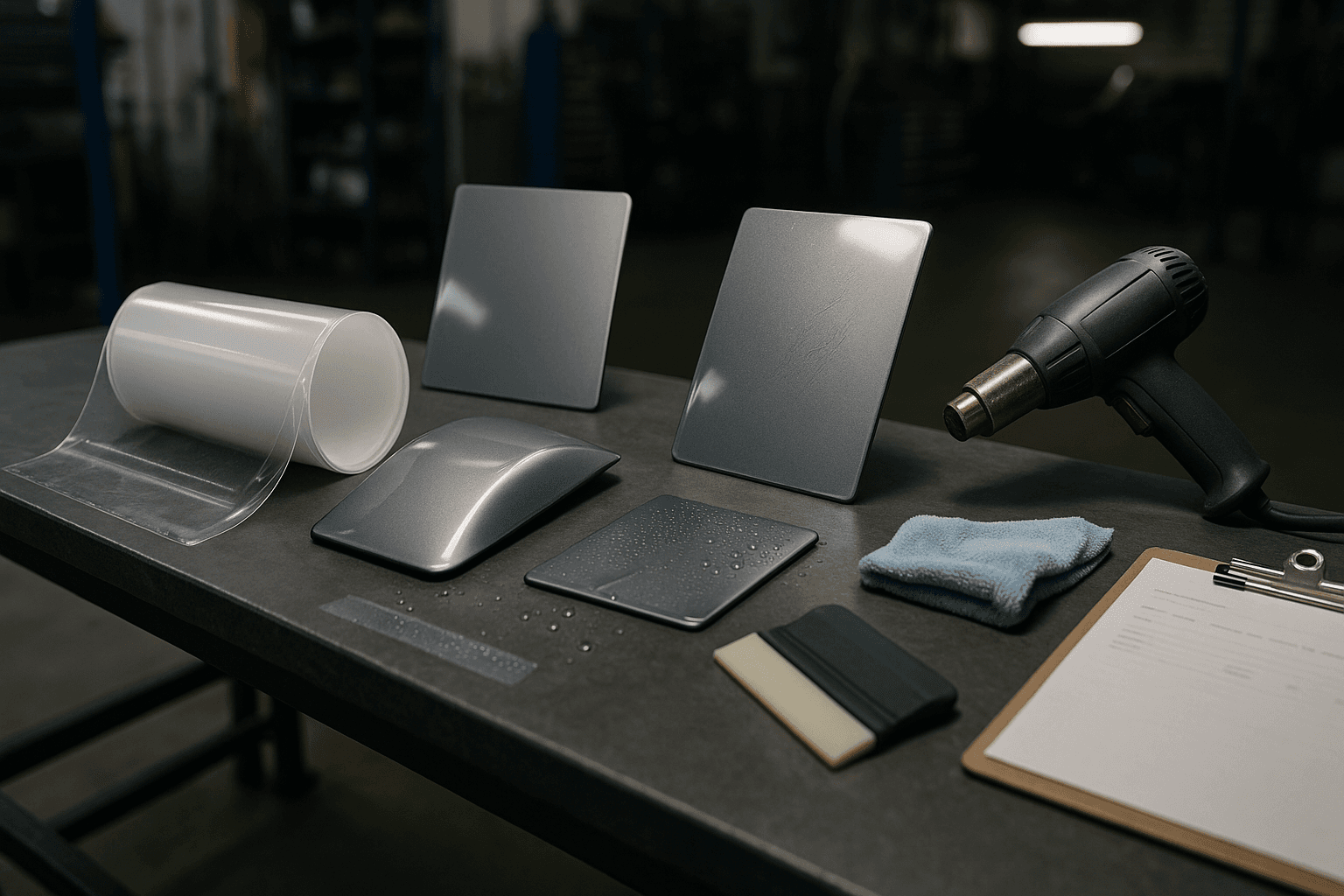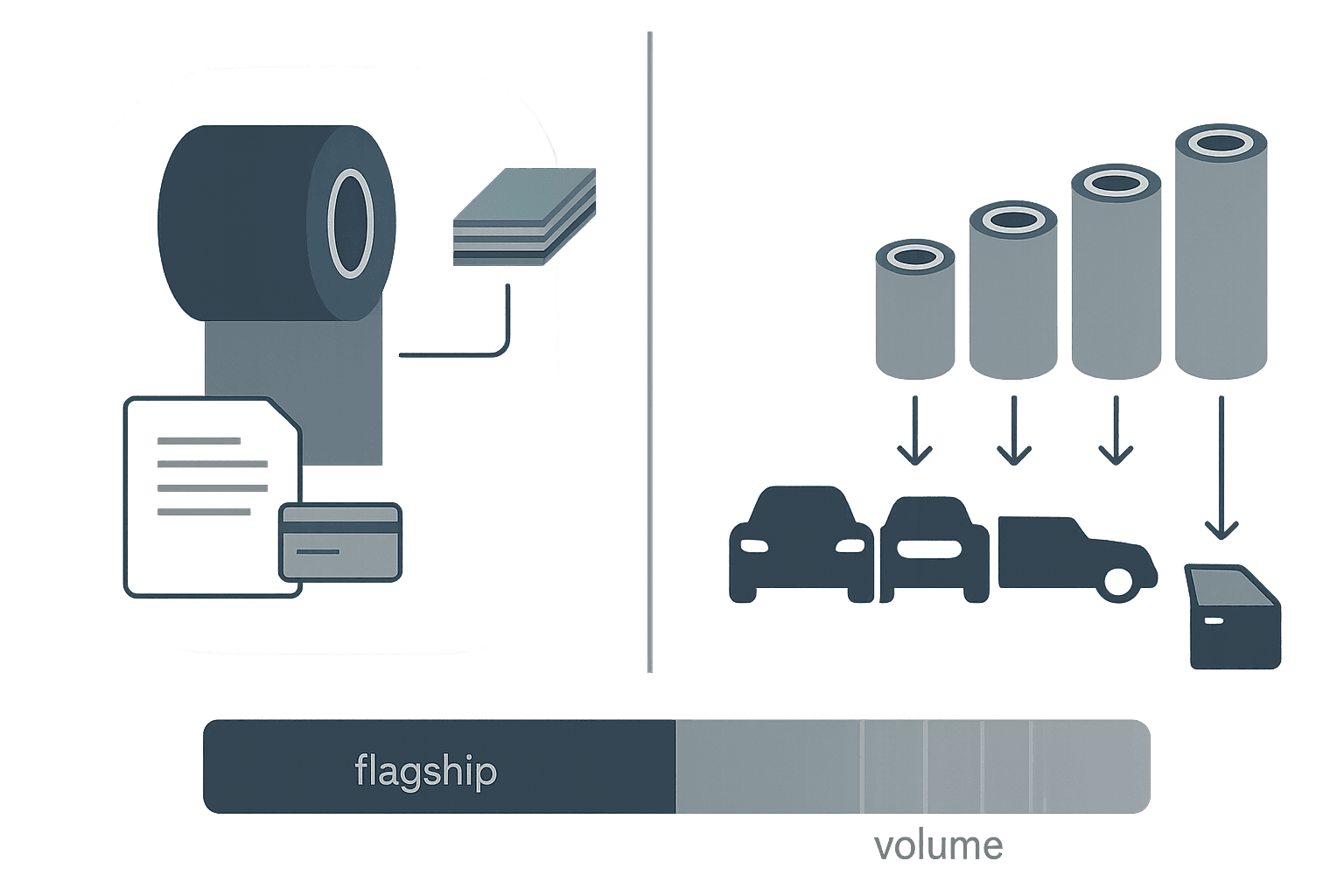
Premium PPF is different from mainstream clear film when it is a named flagship SKU with its own spec sheet, mil rating, and warranty card. Volume film is a thickness ladder you stock by job. Extra mil and a hotter healing demo are not the split. An adjective on generic 7.5 mil TPU is not premium construction.

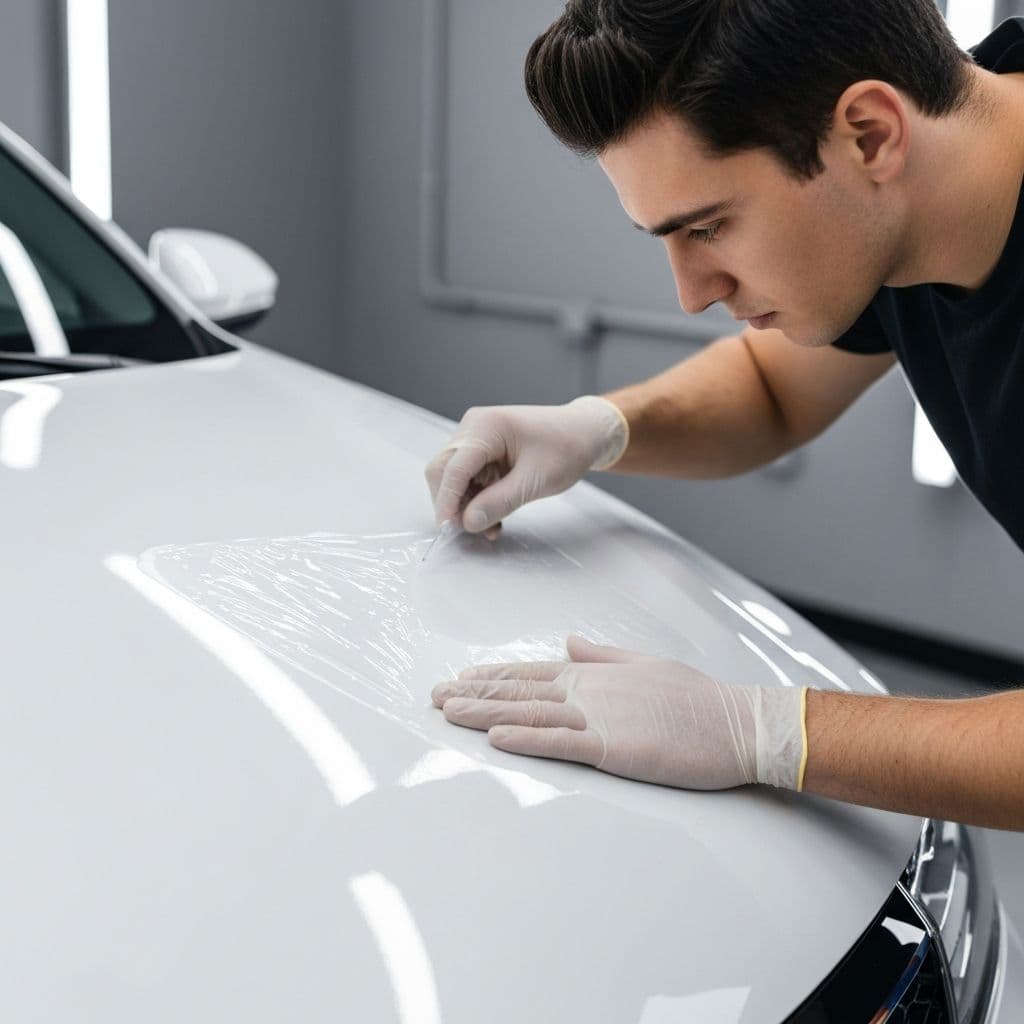
Paint protection film is a thermoplastic urethane layer, often with a self-healing topcoat, applied to painted panels against chips and light abrasion [1]. TPU is a polymer class that becomes pliable when heated and hardens when cooled [2]. That class is shared. What makes premium PPF different is whether purchasing can put two different jobs on two different codes — flagship gloss work versus volume installs — without treating one generic roll as both.
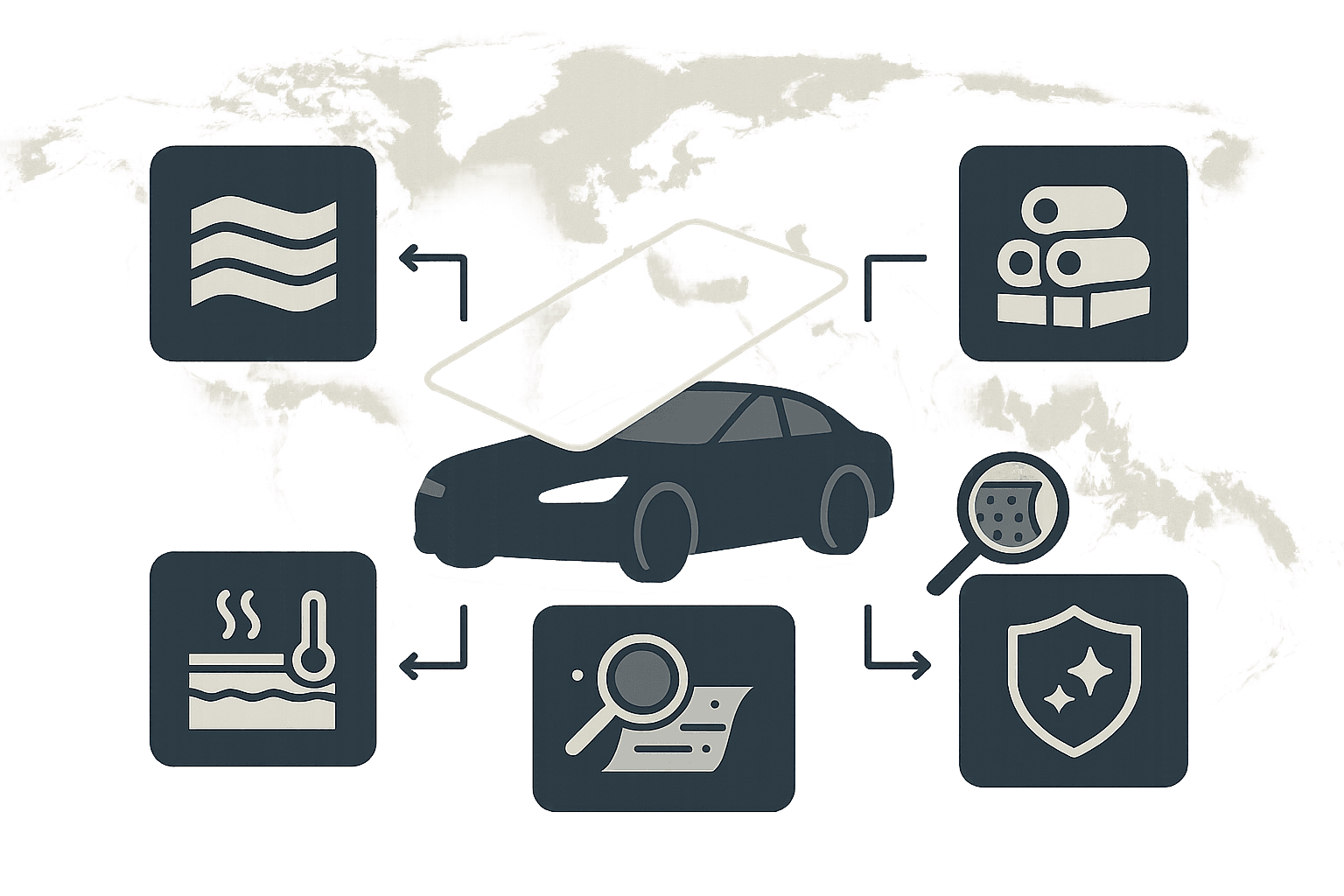
Country of origin is a different job. Bay testing is a different job. Self-healing ranking is a different job. This page is the line split: premium ppf vs mainstream, on paper you can reorder.
The split wholesale buyers can actually check

Write flagship vs volume ppf against the SKU, not against the adjective.
A specification is a set of documented requirements a material or product must satisfy [3]. Premium ppf construction, in a buying sense, is that sheet. If the factory cannot produce one for the flagship code and a separate one for the volume code, you do not have a premium line. You have a brochure.
| What you are deciding | Premium / flagship | Mainstream / volume |
|---|---|---|
| Why the shop opens that roll | Gloss and clarity on higher-value jobs | Job type: tight curves vs high-impact panels |
| What purchasing orders | One named flagship code | A thickness ladder with model codes |
| Thickness | Often still 7.5 mil [5] | 6.5 / 7.5 / 8.5 / 10 mil by job [5] |
| Healing | The trigger on **that** SKU’s sheet [4] | The trigger on **that** SKU’s sheet [4] |
| Warranty | The card that ships with the flagship, **up to**, confirmed per order | The card that ships with that volume model — not copied from the flagship |
| Fail | “Premium TPU” with no model | “Standard 7.5 mil” with no model |
In US industrial language, 1 mil = 0.001 in [5]. High end ppf vs standard is not “10 mil wins.” A volume 10 mil high-stress SKU is still volume. A flagship 7.5 mil SKU can still be the premium clear film shops lead with.
Healing class is not the split. Autonomous self-healing needs no human intervention; polymer systems may instead need a stimulus such as temperature [4]. A thermoplastic becomes pliable at elevated temperature and solidifies on cooling [7]. That explains a heat-gun demo. It does not make the demo a premium upgrade. Room-temperature healing is a different SKU, not a higher grade of the same SKU.
Premium clear PPF characteristics that are not a certificate
Buyers ask what is premium tpu ppf as if the surface could answer. It cannot, by itself.
- Gloss and haze. Look at an angle in shop light. Orange peel shops will refuse is a fail on a flagship code. It is also a fail on a volume code. The difference is which jobs you put that code in front of, not whether haze is allowed.
- Water beading. Hydrophobic surfaces show a high water contact angle [9]. Beading after a wash is a wetting check. It is not a premium certificate.
- Named paper trail. A published brand SKU states heat-applied healing on a named page [8]. Demand that kind of sheet for the flagship code. Replica, “same as,” or official-alternative language is a stop. An XPEL alternative is positioning for a local flagship story. It is not a construction result.
- ISO talk. ISO 9001:2015 specifies requirements for a quality management system [6]. Process talk does not name the flagship SKU. Do not publish a certificate number as proof that the roll is premium.
Judge PPF quality the same way on both codes. Run the receiving checklist on the first wholesale shipment of each. Premium is not a skip.
How XPSHELL maps flagship vs volume
XPSHELL is a China-based automotive film manufacturer. Map the split to named series, then request samples of the flagship code and the volume codes you will actually stock. Film conversion stays on paint protection film.
| Series | Role in the line | Models | Thickness | Healing to confirm | Warranty to confirm per order |
|---|---|---|---|---|---|
| Apex | Premium / flagship gloss | A-75 | 7.5 mil | Heat-activated | Up to 10 years |
| Master | Mainstream / volume ladder | M-65, M-75, M-85, M-100 | 6.5 / 7.5 / 8.5 / 10 mil | Heat-activated | Up to 8 years |
| Rapid | Cold-market trigger, not the flagship | R-75 | 7.5 mil | Room-temperature | Up to 5 years |
| Finish | Restyle tier, not premium clear | Matte, Satin, Gloss Black, Matte Black | 7.5 mil | Do not assume the clear-line healing story | Up to 8 years |
Apex is the premium gloss SKU for shops that sell finish. Master is the volume ladder: M-75 is the core wholesale 7.5 mil; M-65 for tight curves; M-85 and M-100 for higher impact. Rapid is a different trigger. Do not present it as a higher grade of Apex. Finish is a matte/satin/black add-on so the clear ladder does not have to change. Do not claim self-healing on Finish in public copy until that SKU is tested.
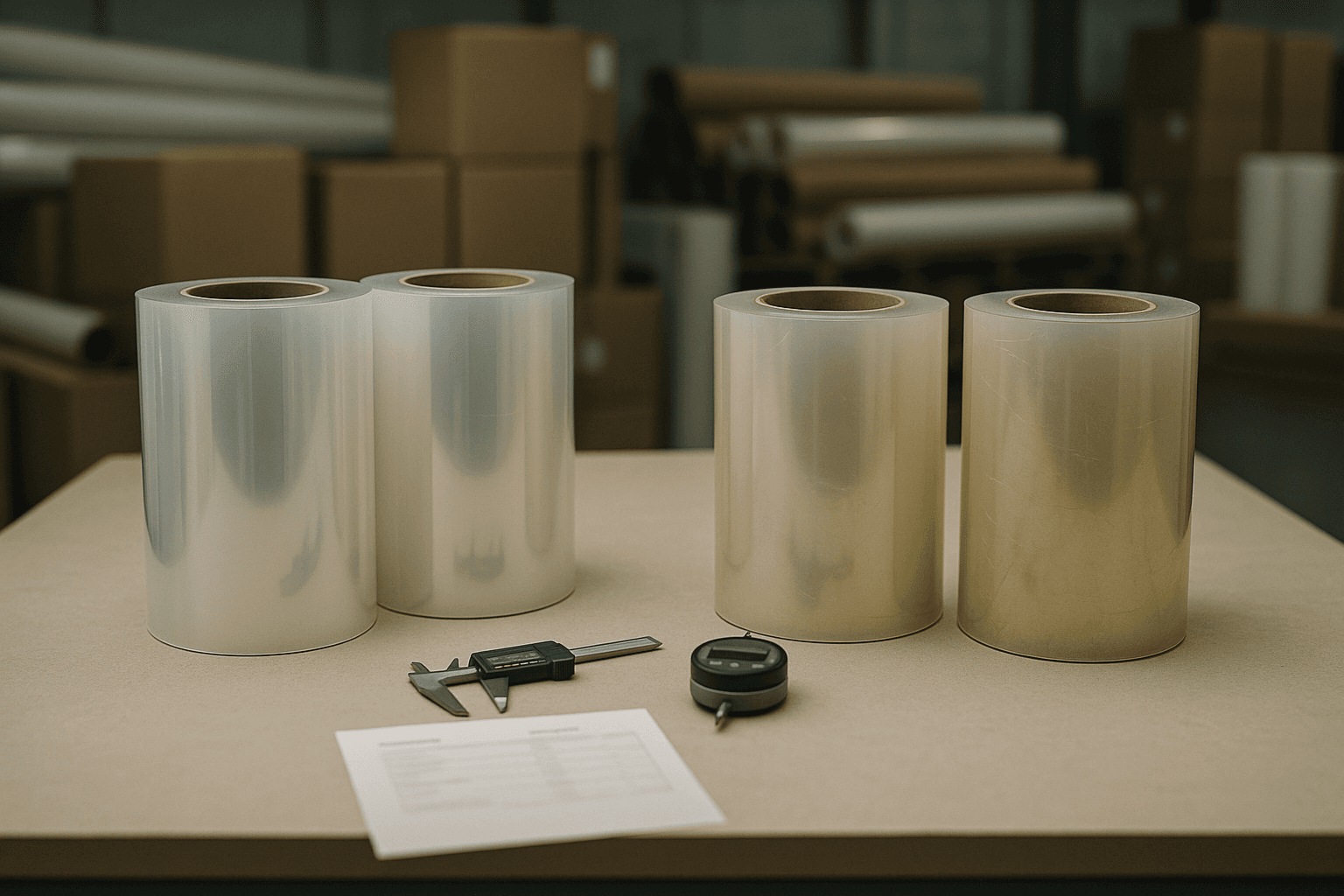
Typical clear roll format is 1.52 m × 15 m. Confirm it. Do not assume. ISO 9001 is a current site claim without a published certificate number or scope [6]. Do not name third-party resin brands in this split.
A China PPF manufacturer can ship both a flagship code and a volume ladder. Origin does not decide which SKU is premium. If the listing only says imported TPU, you still do not have the table.
What to stock after you accept the split
Keep two jobs on two codes.
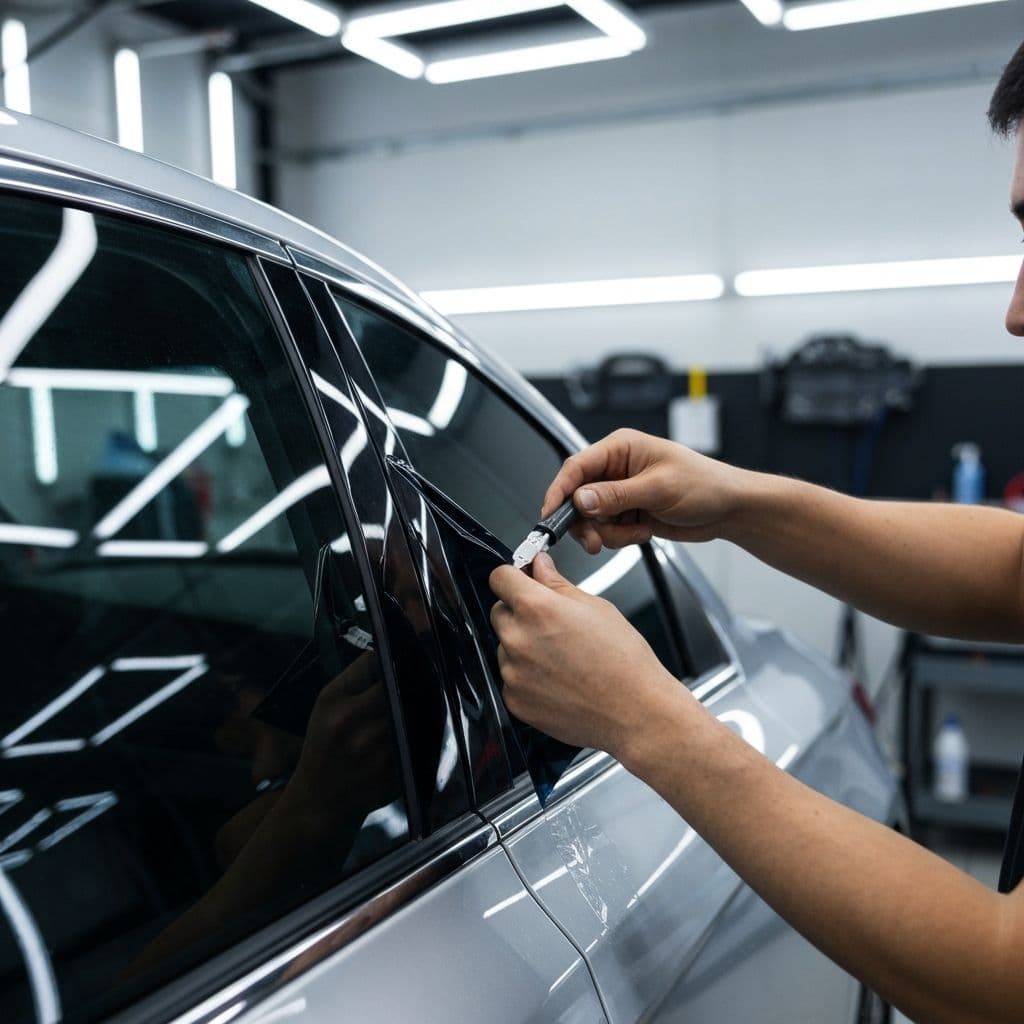
1. Lock the flagship. A-75-style gloss on the jobs that sell finish. Quote, liner, and carton share that code [3] [5]. 2. Lock the volume ladder. Do not force every bumper and every hood onto the flagship roll. 3. Do not mix triggers. A heat-gun demo does not prove Rapid [4] [7]. 4. Do not copy the Apex year count onto Master. Series cards stay series cards. 5. Sample both. When you can, install the flagship code and the core volume code. A leftover wrap from a mixed pack is not a line test.
The shop protocol lives on the wholesale bay test. Country grade lives on Chinese TPU PPF quality. Healing ranking is a later article. Stay here until you can say which code is flagship and which codes are volume.
When those codes pass, request samples of both, then lock a wholesale quote. A distributor program conversation comes after the line split, not instead of it. Packaging talk goes through OEM after the film passes.
FAQ
What makes premium PPF different from mainstream clear film?
A named flagship SKU with its own sheet, mil [5], and series warranty, versus a volume thickness ladder you stock by job. An adjective on generic TPU is not the difference. Then request samples of both codes.
How should I read premium ppf vs mainstream on a quote?
If purchasing cannot put two model codes on the PO, you do not have a split [3]. Flagship vs volume ppf is two SKUs. Request samples of those codes, then a wholesale quote.
What is the premium ppf difference that shops can sell?
Gloss and clarity on the flagship code, on jobs that pay for finish. Haze at an angle is a fail on that code. It is not a hydrophobic certificate [9]. Request samples of the flagship SKU, not a mixed pack.
What is premium TPU PPF if healing looks the same?
TPU is a polymer class [2]. Heat-activated healing on two SKUs is the same class claim [4] [7], not a grade. Premium tpu ppf is still the named flagship sheet. Room-temperature healing is a different SKU. Request samples of the code you will sell as flagship.
Which premium clear ppf characteristics actually belong on a PO?
Model code, mil that matches the liner [5], healing trigger on that sheet [4], and the warranty card written as up to. Water beading and ISO 9001 are not the PO [6] [9]. Request samples, then copy the job card onto the quote.
Is high end ppf vs standard just a thicker film?
No. Thickness is a job choice [5]. A 10 mil volume SKU is still volume. A 7.5 mil flagship SKU can still be the premium clear film. Request samples of both.
Does premium ppf construction mean more layers?
Not in public copy unless the named sheet for that SKU states it. Construction, for a buyer, is documented requirements [3] plus a paper-trail example of a named SKU [8]. Do not invent layer counts. Request samples of the codes on the sheet.
Can an XPEL alternative be the flagship and not the volume line?
Yes. An XPEL alternative is positioning. Run the same split: flagship code for gloss jobs, volume ladder for the rest. Replica language is a stop. After the film passes, a distributor program or OEM conversation is allowed. Request samples of the flagship code you will actually sell.
References
- [1] Paint protection film
- [2] Thermoplastic polyurethane
- [3] Specification (technical standard)
- [4] Self-healing material
- [5] Thickness (NIST OSAC lexicon / ASTM E1732)
- [6] ISO 9001:2015 Quality management systems — Requirements
- [7] Thermoplastic
- [8] Scotchgard Paint Protection Film Pro Series 200
- [9] Hydrophobe