Tesla Defects, Panel Gaps and Paint Issues: Delivery Checklist Before PPF
Tesla owners are some of the most active online researchers in the automotive market. Before or after delivery, many search for tesla defect, tesla defects, tesla panel gap, tesla panel gaps, tesla gaps, tesla door alignment, tesla paint defect and tesla paint because they want to know what is normal, what should be reported, and what should be protected.
For installers and Tesla-focused PPF shops, this creates an important content opportunity. The customer may not be ready to buy paint protection film immediately. They may simply be asking:
- Is this panel gap normal?
- Should the door alignment be fixed?
- Is this a paint defect or just contamination?
- Can PPF cover scratches or chips?
- Should I install PPF before or after Tesla service?
The right answer is not “install PPF now.”
The right answer is:
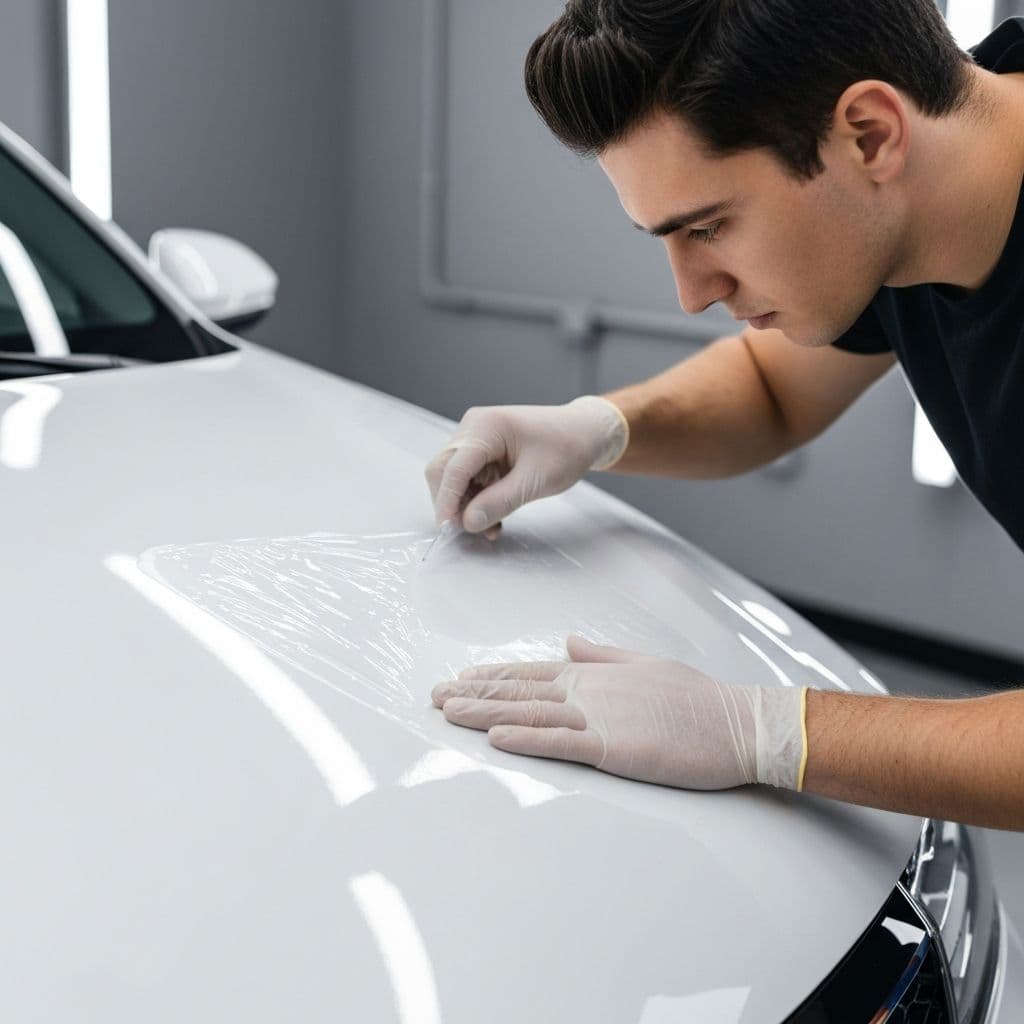
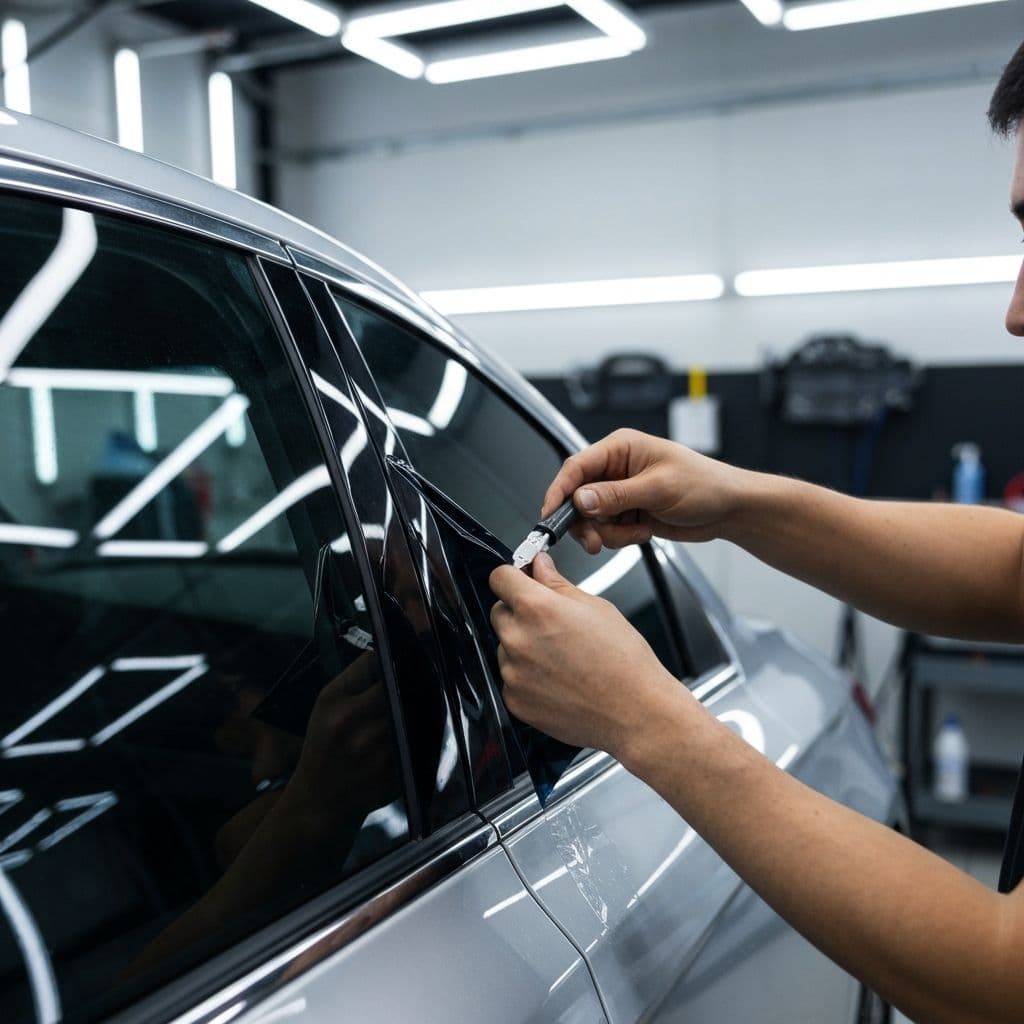
PPF should not be used to hide unresolved quality issues. It should be installed after the car’s paint, panels and high-impact areas are inspected, documented and accepted.
That is why a Tesla delivery checklist before PPF is useful. It protects the owner, protects the installer and helps shops build trust before recommending a Tesla PPF package.
Why Tesla defect searches matter before PPF
A Tesla defect search usually comes from uncertainty. The owner has noticed a gap, scratch, paint mark, door fitment issue or surface defect and wants to understand whether it is serious.
For SEO, this is valuable because the search intent happens before the commercial PPF intent. A customer searching “tesla panel gap” may later search “tesla ppf cost,” “tesla ppf package” or “paint protection film for Tesla Model Y.”
For a PPF shop or manufacturer, this page should not push a product too early. It should educate first.
| Search intent | What the user really wants | Best content response | Natural next page |
|---|---|---|---|
| tesla defect | Understand whether an issue is normal | Delivery inspection checklist | Tesla PPF Guide |
| tesla panel gap | Compare left/right body alignment | Panel gap and door alignment guide | Tesla PPF Packages |
| tesla paint defect | Identify paint flaws before protection | Paint inspection checklist | Tesla Paint Protection Film Cost |
| tesla scratches | Know whether scratches can be prevented | Explain PPF limits and protection zones | Tesla PPF Guide |
| ppf sample books tesla shops | Compare film options for Tesla packages | Shop-facing sample and package guide | PPF Sample Books for Tesla Shops |
| ppf manufacturer for installers | Find reliable supply for Tesla-focused shops | B2B film selection and testing guide | PPF Manufacturer for Installers |
This is the commercial logic of the cluster: capture information traffic first, then guide qualified readers toward PPF education and package selection.
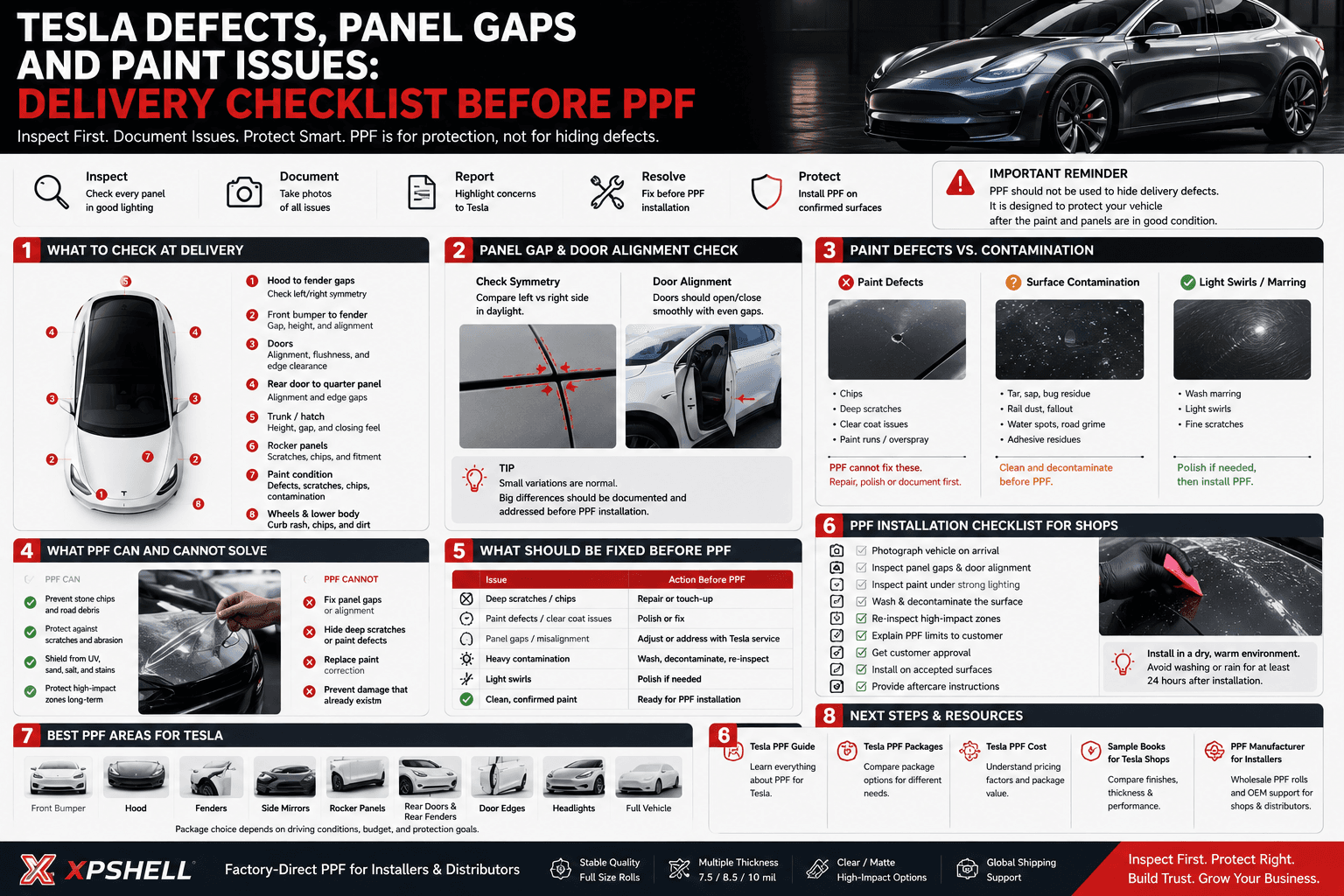
What Tesla buyers should check at delivery
Tesla delivery inspection should be simple, visual and documented. Owners do not need to become body shop technicians. They only need to separate obvious delivery concerns from normal surface marks and decide whether the vehicle is ready for PPF.
Panel gap symmetry
Panel gaps should be checked by comparing the left and right sides of the vehicle. The important question is not whether every gap is mathematically identical. The question is whether the gap looks obviously uneven, whether a panel sits too high or too low, or whether one side looks very different from the other.
Check these areas:
| Area | What to inspect | Why it matters before PPF |
|---|---|---|
| Hood to fender | Left/right gap consistency | Uneven alignment may be more visible after film |
| Front bumper to fender | Gaps, clips, edge position | Film edges depend on stable panel fitment |
| Door to fender | Gap and flushness | Door movement can affect film edge planning |
| Rear door to quarter panel | Alignment and edge clearance | Common area for impact protection |
| Trunk or hatch | Height, gap and closing feel | PPF cannot correct hatch alignment |
| Charging port area | Fitment and paint edges | Small edges require careful installation |
PPF cannot move panels. If a panel gap is severe enough to bother the owner, it should be documented before PPF.
Door alignment
Door alignment is not only a visual issue. It can affect how the door opens, closes and clears adjacent panels. A poorly aligned door may create edge friction, uneven spacing or a higher risk of film edge contact.
Before PPF, check:
- Does each door open and close smoothly?
- Does the door edge touch or nearly touch another panel?
- Is the door flush with the fender and rear quarter panel?
- Are the left and right side gaps similar?
- Is there any paint damage near door edges?
If door alignment affects panel clearance, resolve it before installing film on door edges, rocker panels or adjacent panels.
Paint defects
A Tesla paint defect may include dust nibs, clear coat texture, scratches, chips, thin paint spots, overspray, sanding marks or paint mismatch. Some issues are minor and can be polished. Others should be reported to Tesla service or a qualified body shop.
Tesla’s owner manual also warns that corrosive substances such as grease, oil, bird droppings, tree resin, dead insects, tar spots, road salt and industrial fallout should be removed promptly to prevent paint damage [1]. This matters because some “paint defects” are actually contamination sitting on top of the paint.
Scratches and chips
PPF can help prevent future scratches, stone chips and road debris damage, but it cannot undo existing damage.
A light surface mark may be polished before PPF. A deep scratch, exposed paint chip or clear coat defect should be documented and corrected first. If the owner accepts the existing condition, the installer should still photograph it before film installation.
Paint defects vs panel gaps vs surface contamination
One common mistake is treating every visible issue as a “defect.” A good Tesla inspection separates the issue into three categories: paint defects, panel alignment issues and surface contamination.
| Issue type | Examples | Can PPF solve it? | Best action before PPF |
|---|---|---|---|
| Paint defect | Chips, deep scratches, dust nibs, clear coat runs, paint mismatch | No | Repair, polish or document first |
| Panel gap or alignment | Uneven hood gap, door misalignment, bumper fitment issue | No | Ask Tesla service or body shop to inspect |
| Surface contamination | Tar, sap, rail dust, water spots, road film, grease | Not directly | Decontaminate before installation |
| Light wash marring | Fine swirls or light marks | Sometimes after polishing | Polish if needed, then install PPF |
| Clean high-impact area | Hood, bumper, mirror, rocker panel, rear door impact zone | Yes | Good candidate for PPF |
Tesla’s own Model Y PPF installation instructions begin by cleaning the installation area with automotive soap and water, drying it with a clean microfiber towel, and making sure dirt and grease are removed [2]. That supports a simple rule for shops:
Do not install PPF over dirty, contaminated or disputed paint.
What PPF can and cannot solve
Paint protection film is a protective layer. It is not a repair method, not a body alignment tool and not a way to hide delivery problems.
| Customer question | Correct answer |
|---|---|
| Can PPF fix Tesla panel gaps? | No. PPF cannot correct panel alignment. |
| Can PPF hide paint defects? | Usually no. Clear film may still show the defect underneath. |
| Can PPF prevent future stone chips? | Yes, especially on high-impact zones. |
| Can PPF protect against road salt, sand and debris? | Yes, when installed on exposed areas. |
| Can PPF replace paint correction? | No. Paint should be corrected before film if needed. |
| Can PPF protect door edges and rocker panels? | Yes, if the surface is clean and properly prepared. |
| Can PPF solve scratches that already exist? | No. Existing scratches should be polished, repaired or documented first. |
Tesla’s own Model Y Paint Protection Film product page describes PPF as protection from snow, salt, sand, small debris, stone chips and driving conditions that accelerate wear [3]. This is a useful way to explain PPF to owners: it is mainly for future protection, not for hiding unresolved defects.
What should be fixed before PPF installation
Before PPF installation, owners and shops should agree on what needs correction, what only needs cleaning, and what can be safely protected.
Fix or document paint damage first
Do not rush into PPF if the vehicle has:
- Deep scratches
- Visible stone chips
- Clear coat defects
- Paint runs
- Severe orange peel or texture issues
- Paint mismatch
- Exposed primer or metal
- Customer-disputed delivery damage
If the customer still wants PPF over the area, the installer should document the condition with photos and written approval.
Resolve serious panel alignment concerns
If a Tesla owner is concerned about a panel gap, bumper fitment issue or door alignment problem, fix or document that issue before PPF.
This is especially important near:
- Door edges
- Front bumper corners
- Hood and fender edges
- Rear doors and quarter panels
- Trunk or hatch edges
- Rocker panel transitions
A panel adjustment after PPF may damage film edges or require reinstallation.
Decontaminate the paint
A Tesla may look new but still have transport film residue, rail dust, tar, road grime, water spots or adhesive marks. These must be removed before installation.
The basic process should include:
| Step | Purpose |
|---|---|
| Wash | Remove loose dirt and road film |
| Chemical decontamination | Remove iron fallout, tar or organic contamination |
| Clay or mechanical decontamination | Remove bonded surface particles |
| Paint inspection | Check whether defects remain after cleaning |
| Polish if needed | Improve clarity before film |
| Final surface prep | Ensure the film bonds to clean paint |
Which Tesla areas are best for PPF after inspection
Once the car has passed inspection, PPF becomes a practical long-term protection option. The best coverage depends on driving conditions, budget and customer expectations.
| PPF area | Why it matters for Tesla owners | Recommended package logic |
|---|---|---|
| Front bumper | Highest exposure to stones and road debris | Entry package or full-front package |
| Hood | Large visible panel, highway impact zone | Full-front package |
| Front fenders | Completes front-end protection | Full-front package |
| Side mirrors | Bug impact, debris and scratches | Usually included in full front |
| Rocker panels | Road spray, salt, sand and lower-body abrasion | Daily-driver or high-impact package |
| Rear doors and rear fenders | Common impact zone on Model Y and Model 3 | Tesla-specific protection package |
| Door edges | Parking lot contact and daily use | Add-on protection |
| Headlights | Sand, UV exposure and road debris | Headlight PPF add-on |
| Full car | Maximum protection and finish consistency | Premium or matte/color package |
Tesla’s own Model Y PPF kit focuses on rear doors/fenders and is positioned for protection from snow, salt, sand, small debris and stone chips [3]. That gives shops a strong educational point: Tesla owners often need more than just the front bumper. Lower-body and rear-door impact zones can be highly relevant depending on the vehicle and market.
PPF installation checklist for Tesla shops
A Tesla-focused PPF shop should use a repeatable inspection workflow before quoting or installing film.
| Step | Shop action | Why it protects the shop |
|---|---|---|
| 1 | Photograph the car on arrival | Creates condition record |
| 2 | Inspect panel gaps and door alignment | Separates body issues from film issues |
| 3 | Inspect paint under strong lighting | Finds scratches, chips and defects |
| 4 | Wash and decontaminate | Removes false defects and improves adhesion |
| 5 | Reinspect high-impact zones | Confirms whether PPF is suitable |
| 6 | Explain what PPF can and cannot solve | Prevents unrealistic expectations |
| 7 | Get customer approval | Reduces disputes |
| 8 | Install only on accepted surfaces | Improves final result |
| 9 | Give aftercare instructions | Reduces edge lift and early wash issues |
Tesla’s Model 3 DIY PPF instructions also advise installing the film when it is dry and warm outside, and avoiding washing or rain for at least 24 hours after installation [4]. Shops can use this as a simple aftercare message: early curing conditions matter.
How to explain this to Tesla owners
The best sales conversation is not aggressive. It should sound like inspection guidance.
A shop can say:
“Before we install PPF, we first inspect the Tesla paint, panel gaps, door alignment and high-impact areas. If there are paint defects, deep scratches or alignment issues, those should be documented or corrected first. PPF protects the paint condition we install it over. It is not meant to hide delivery problems.”
This message works because it respects the owner’s concern. It also separates three different topics:
| Owner concern | Shop explanation |
|---|---|
| “Is this a Tesla defect?” | We can help document visible paint and panel concerns. |
| “Can PPF cover this?” | PPF protects, but it does not repair existing defects. |
| “Should I wait for service?” | If the issue may require paint or panel adjustment, fix it first. |
| “Which package do I need?” | After inspection, choose coverage based on risk zones and driving habits. |
For SEO conversion, this is where the article should guide readers to related pages:
- Tesla PPF Guide
- Tesla PPF Packages
- Tesla Paint Protection Film Cost
- PPF Sample Books for Tesla Shops
- PPF Manufacturer for Installers
Where XPSHELL fits for Tesla shops and installers
XPSHELL should not be introduced as a product pushed at every Tesla owner. On this type of information page, XPSHELL should be positioned as a practical supply and package-building option for shops.
For example:
“After inspection, Tesla-focused shops can use XPSHELL PPF sample books and roll options to build clear, matte or high-impact packages for different customer needs. The key is not to sell film over unresolved defects, but to protect clean, accepted paint with the right coverage plan.”
This fits the page because the customer journey is:
- Owner searches Tesla defects or panel gaps.
- Owner learns what should be checked before PPF.
- Owner understands PPF cannot hide quality issues.
- Owner sees which areas are worth protecting after inspection.
- Installer or distributor clicks into Tesla PPF Guide, PPF Packages, Sample Books or PPF Manufacturer pages.
For B2B visitors, the XPSHELL angle is stronger:
| B2B need | XPSHELL content angle |
|---|---|
| Tesla shops need sample books | Offer clear, matte and high-impact film samples |
| Installers need package design | Build entry, full-front, daily-driver and full-car packages |
| Distributors need repeatable supply | Factory-direct PPF rolls and OEM support |
| Shops need customer education | Use checklists to reduce disputes before installation |
| Markets need different thickness options | Match 7.5, 8.5 or 10 mil PPF to customer use cases |
This keeps the page educational while still creating a path toward commercial pages.
Recommended internal links
Use the following internal links naturally inside the page:
| Anchor text | Suggested destination | Why it fits |
|---|---|---|
| Tesla PPF Guide | Tesla PPF educational guide | For owners who passed inspection and want protection |
| Tesla PPF Packages | Package comparison page | For shops explaining coverage options |
| Tesla Paint Protection Film Cost | Cost and package pricing page | For commercial intent after education |
| PPF Sample Books for Tesla Shops | Sample book page | For installers comparing film options |
| PPF Manufacturer for Installers | B2B supplier page | For shops and distributors looking for wholesale supply |
Suggested internal link sentence examples:
“After the Tesla paint inspection is complete, owners can compare coverage options in our Tesla PPF Guide.”
“For installers, the next step is to build clear packages such as front bumper, full front, rocker panel and full-car coverage. See Tesla PPF Packages for a practical structure.”
“Shops that want to compare clear, matte and high-impact film options can request PPF Sample Books for Tesla Shops.”
FAQ
What Tesla defects should I check at delivery?
Check panel gaps, door alignment, bumper fitment, hood and trunk alignment, paint defects, scratches, chips, water spots, trim fitment, wheel damage and high-impact areas such as the front bumper, hood, mirrors, rocker panels and rear doors.
Are Tesla panel gaps normal?
Small panel gap differences can happen on many vehicles, but obvious left/right asymmetry, poor door closing, misaligned bumpers or uneven hatch fitment should be documented before accepting the vehicle or before PPF installation.
Can PPF fix Tesla panel gaps?
No. PPF cannot fix Tesla panel gaps or door alignment issues. It only follows the surface and edges of the vehicle. Alignment problems should be handled before film installation.
Can PPF hide Tesla paint defects?
Usually no. Clear PPF may still show scratches, chips, clear coat defects or paint texture underneath. In some cases, film gloss can make the underlying defect easier to notice.
Should Tesla paint defects be fixed before PPF?
Yes. Deep scratches, chips, clear coat problems, paint mismatch and disputed delivery damage should be corrected or documented before PPF. PPF should protect accepted paint condition, not hide unresolved problems.
What is the difference between paint defects and surface contamination?
Paint defects are problems in the paint or clear coat, such as chips, scratches or paint runs. Surface contamination sits on top of the paint, such as tar, sap, grease, rail dust or road grime. Contamination should be removed before PPF.
Which Tesla areas should get PPF first?
The most practical first areas are front bumper, hood, fenders, mirrors, rocker panels, lower doors, rear doors and rear fenders. The best package depends on driving conditions and budget.
Should I install PPF before or after Tesla service?
If there are unresolved paint or panel issues, handle Tesla service first. If the vehicle condition is accepted and the paint is clean, PPF can be installed to protect against future wear.
Why do Tesla shops need a delivery checklist before PPF?
A checklist helps shops document pre-existing issues, explain what PPF can and cannot solve, avoid customer disputes and recommend the right protection package based on the car’s actual condition.
Can XPSHELL help Tesla PPF shops?
Yes. XPSHELL can support Tesla-focused shops with PPF sample books, clear and matte film options, roll supply, OEM support and package-building logic for installers and distributors. The correct approach is to inspect first, then protect accepted paint with the right film and coverage plan.
References
[1] Tesla Model Y Owner’s Manual - Cleaning (https://www.tesla.com/ownersmanual/modely/en_us/GUID-65384C1F-86F2-44E8-A8BC-8A12E7E00A40.html)
[2] Tesla Model Y Do It Yourself - Installing Paint Protection Film Kit (https://service.tesla.com/docs/Public/diy/modely/en_us/GUID-2F1B673E-A1F4-4A4C-BDA9-BF43412035F1.html)
[3] Tesla Shop - Model Y Paint Protection Film (https://shop.tesla.com/product/model-y-paint-protection-film)
[4] Tesla Model 3 Do It Yourself - Installing Paint Protection Film Kit (https://service.tesla.com/docs/Public/diy/model3/en_us/GUID-2F1B673E-A1F4-4A4C-BDA9-BF43412035F1.html)
[5] Acko Drive - Pre-Delivery Inspection Checklist for New Cars (https://ackodrive.com/car-guide/pre-delivery-inspection-checklist-for-new-cars/)