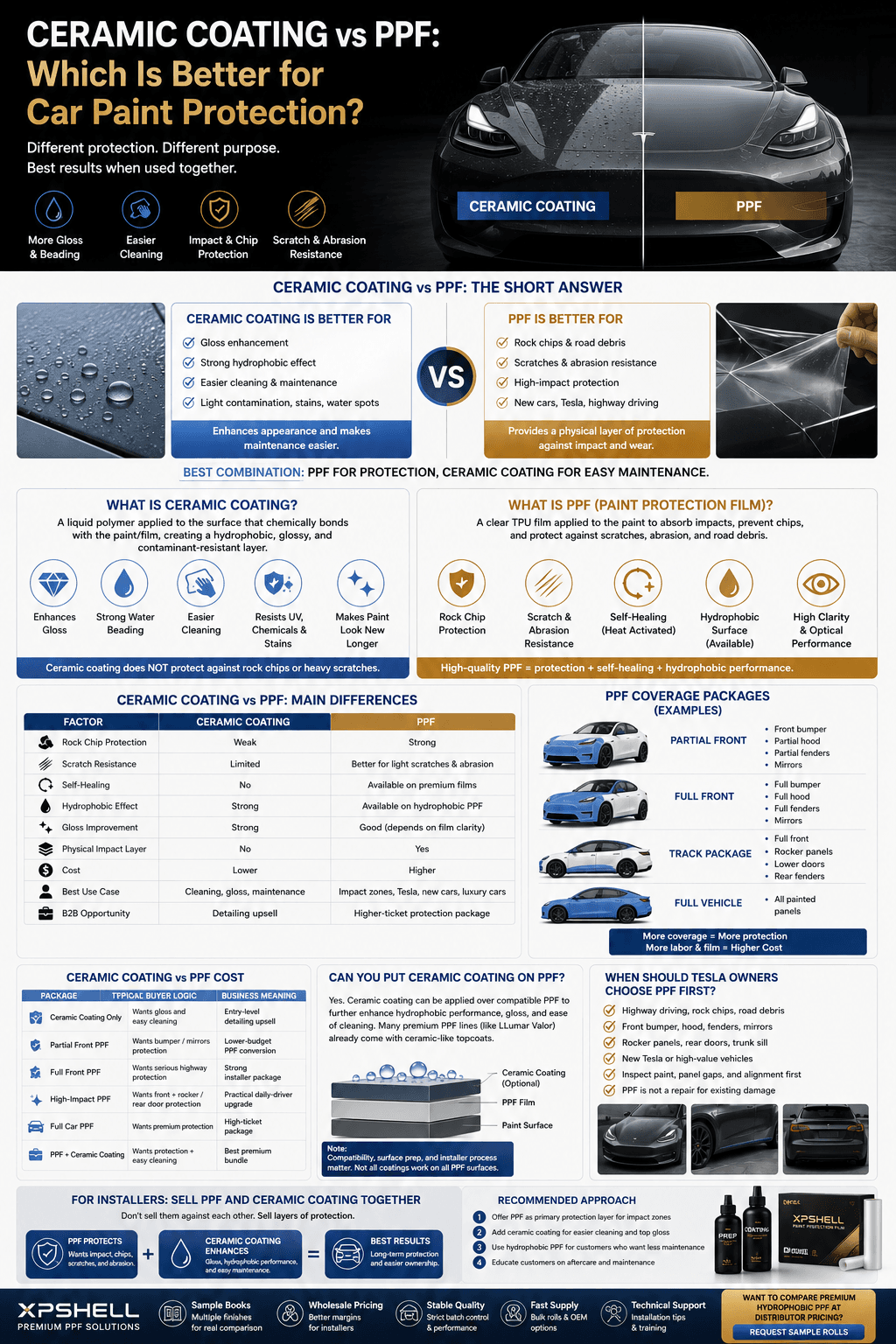
Ceramic Coating vs PPF: The Short Answer
Ceramic coating is better for gloss, water beading and easier cleaning.
PPF is better for rock chips, scratches, abrasion and impact protection.
For high-value cars, Tesla vehicles, new cars, highway driving and front-end protection, PPF usually matters first because it adds a physical film layer over the paint. Ceramic coating can be added over compatible PPF to improve maintenance, water behavior and surface slickness.
The simplest way to explain ceramic coating vs paint protection film is this:
| Question | Better answer |
|---|---|
| I want easier washing and stronger water beading | Ceramic coating |
| I want more gloss and slickness | Ceramic coating |
| I want protection from rock chips | PPF |
| I want protection from road debris and abrasion | PPF |
| I want front bumper, hood and fender protection | PPF |
| I want both impact protection and easier cleaning | PPF plus ceramic coating |
| I want a premium one-layer story | Hydrophobic PPF or ceramic-like PPF |
This is why installers should not sell ceramic coating against PPF. They solve different problems. PPF protects against impact. Ceramic coating improves surface maintenance.
What Is Ceramic Coating?
Ceramic coating is a liquid coating applied to automotive paint, PPF, vinyl, trim, wheels or other compatible surfaces. Its main job is to improve surface slickness, water beading, gloss and cleaning behavior.
3M's Ceramic Coating technical data describes it as a professionally applied coating that enhances depth and luster, provides a slick surface for easy maintenance, and creates excellent water beading. The same document also says it can be used on paint, film, vinyl, trim, headlights and wheels [1].
What ceramic coating does well
| Benefit | What it means for the customer |
|---|---|
| Gloss enhancement | The paint can look deeper, cleaner and more polished |
| Hydrophobic effect | Water beads and rolls off more easily |
| Easier cleaning | Dirt, bugs and bird droppings may be easier to remove |
| Slick surface | The car feels smoother after proper application |
| Chemical resistance | Helps against some environmental contaminants |
| Maintenance value | Good upsell for detailers and car care shops |
What ceramic coating does not do well
Ceramic coating is not the core solution for stone chips, road debris impact, parking scratches or abrasion from high-impact driving areas. It may help reduce some surface contamination and light washing friction, but it does not replace the physical protection layer of PPF.
A simple customer explanation:
Ceramic coating makes the surface easier to maintain. PPF protects the paint from physical impact.
What Is PPF?
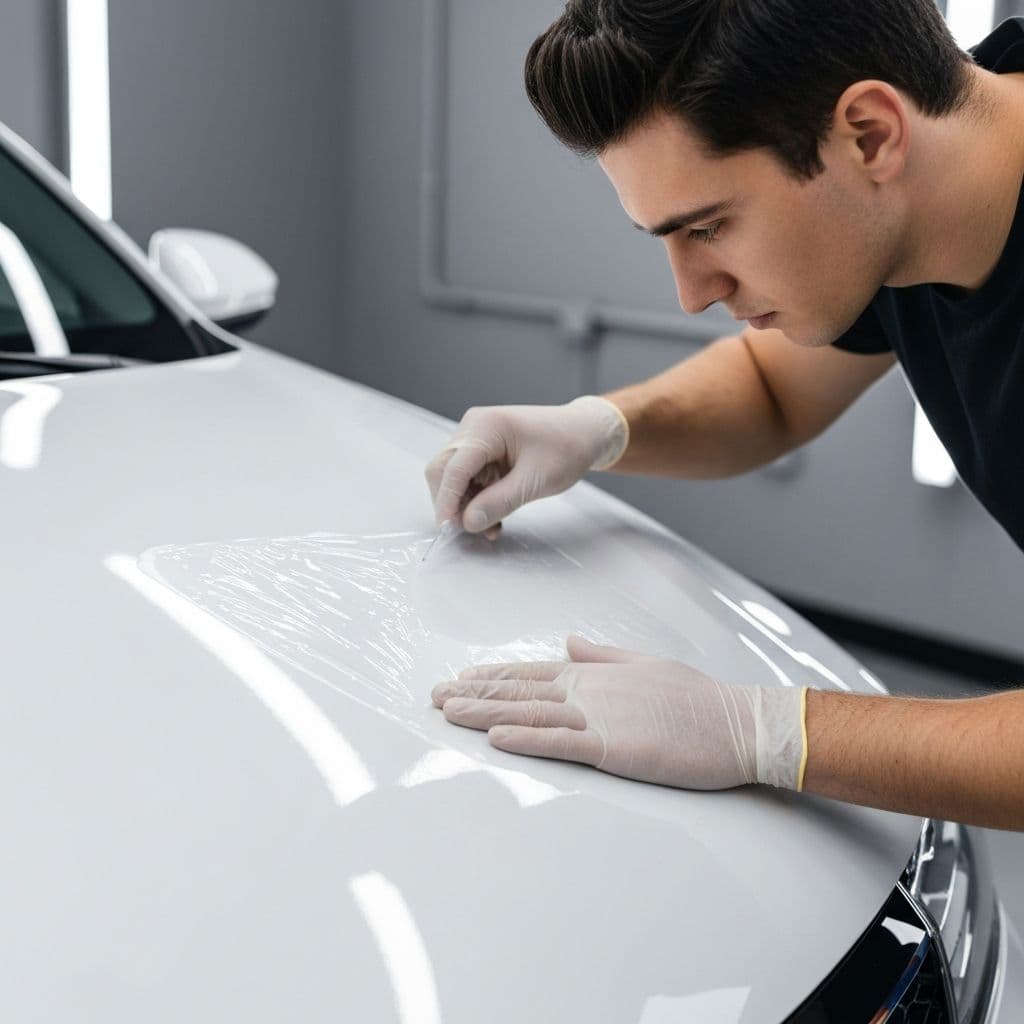
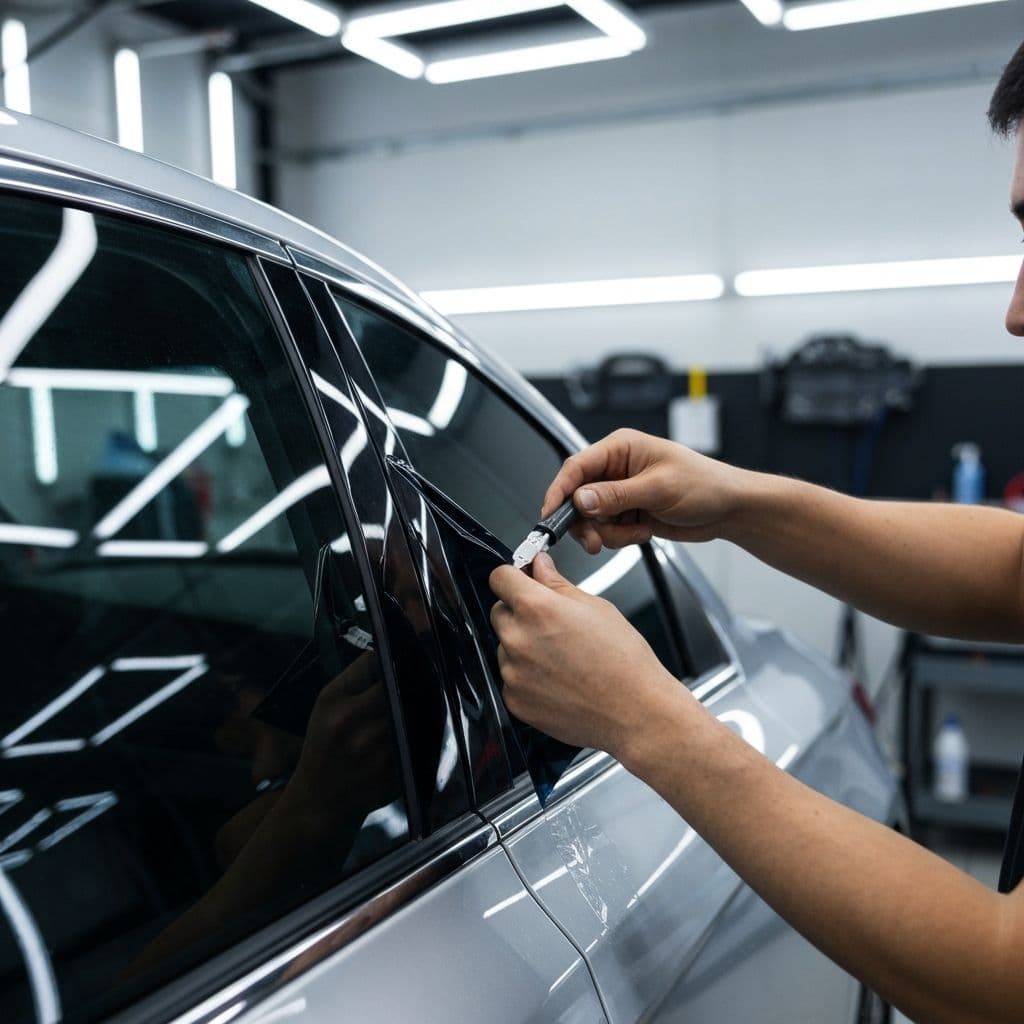
PPF means paint protection film. It is usually a transparent TPU film installed over painted panels to protect against stone chips, scratches, abrasion, road debris, sand, salt and other driving-related risks.
Premium PPF is not just a transparent plastic film. High-end films can include self-healing topcoats, hydrophobic surfaces, better optical clarity, lower orange peel, improved adhesive behavior and better stretch for curved panels.
3M describes Scotchgard Paint Protection Film Pro Series 200 as a film designed to protect vehicle paint from rock chips, scratches and the elements. Its product page also highlights matte and gloss finishes, hydrophobic features, excellent clarity in gloss finish, optimized adhesive for repositioning, and the ability to stretch for bulk installations [2]. 3M's PPF FAQ adds that Pro Series 200 is self-healing for minor scratches or marks with heat applied to the film surface, and that the optimized adhesive helps with working time, repositioning, lift lines and adhesive marks [3].
Common PPF coverage areas
| Area | Why it is protected |
|---|---|
| Front bumper | Highest rock chip and bug impact area |
| Hood | Large visible panel exposed to highway debris |
| Front fenders | Common full front PPF area |
| Side mirrors | Small but high-impact surfaces |
| Rocker panels | Exposed to sand, salt and road debris from tires |
| Rear doors | Common high-impact zone on some vehicles |
| Rear fenders | Exposed to road debris and lower-side abrasion |
| Door cups | Fingernail scratches |
| Door edges | Parking-lot contact |
| Full body | Premium total paint protection |
Ceramic Coating vs PPF: Main Differences
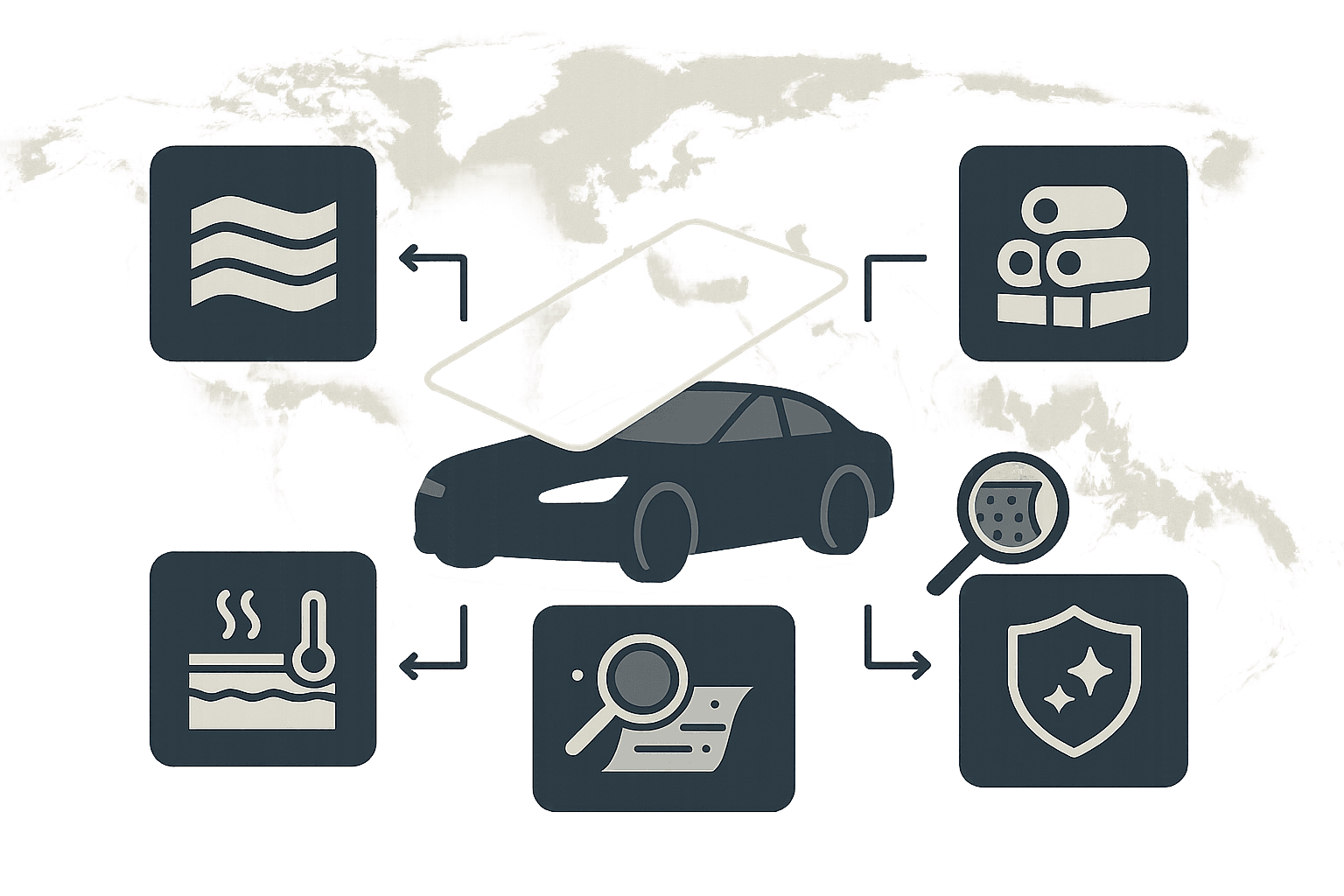
The main difference between ceramic coating and paint protection film is physical thickness and impact protection. Ceramic coating is a surface coating. PPF is a physical film layer.
| Factor | Ceramic Coating | PPF |
|---|---|---|
| Rock chip protection | Weak | Strong |
| Scratch resistance | Limited | Better for light scratches and abrasion |
| Self-healing | No | Available on premium films |
| Hydrophobic effect | Strong | Available on hydrophobic PPF |
| Gloss improvement | Strong | Good, depends on film clarity |
| Physical impact layer | No | Yes |
| Best coverage style | Whole vehicle surface coating | Partial or full vehicle film coverage |
| Cost | Lower | Higher |
| Best use case | Cleaning, gloss, maintenance | Impact zones, Tesla, new cars, luxury cars |
| B2B opportunity | Detailing upsell | Higher-ticket protection package |
For SEO intent, this section should directly answer "ppf vs ceramic coating differences" and "difference between ceramic coating and paint protection film."
The practical conclusion:
Ceramic coating improves the surface. PPF protects the paint.
Which Is Better for Scratches?
For scratches, PPF is usually better than ceramic coating if the customer is talking about physical contact, road abrasion, door-sill scuffs, parking-lot marks, rocker-panel wear or light surface scratches from driving conditions.
Ceramic coating is easier to explain when the customer asks about washing, water spots, gloss, surface slickness and cleaning.
| Customer concern | Better product to recommend | Why |
|---|---|---|
| Wash marks and easier cleaning | Ceramic coating | Improves slickness and cleaning behavior |
| Water beading | Ceramic coating | Strong hydrophobic effect |
| Rock chips | PPF | Needs a physical impact layer |
| Highway debris | PPF | Protects bumper, hood, fenders and mirrors |
| Rocker-panel abrasion | PPF | Film absorbs lower-side wear better |
| Door cups and door edges | PPF | Protects against contact marks |
| Light scratches on film surface | Premium PPF | Some films can self-heal with heat |
| Long-term premium package | PPF plus ceramic coating | Combines impact protection and easy maintenance |
If the customer asks, "what is better ceramic coating or PPF?" the best answer is:
For cleaning and gloss, ceramic coating. For scratches, chips and impact zones, PPF.
Ceramic Coating vs PPF Cost
Ceramic coating vs PPF cost should not be explained as one fixed number. The price depends on coverage, vehicle size, installer labor, paint correction, film type, coating type and local market.
Ceramic coating usually has a lower entry cost because it does not require cutting and installing thick film over each panel. PPF usually costs more because it requires film material, cutting, pattern work, installation labor, edge finishing and more installation skill.
| Package | Typical buyer logic | Business meaning |
|---|---|---|
| Ceramic coating only | Wants gloss and easy cleaning | Entry-level detailing upsell |
| Partial front PPF | Wants bumper / mirrors protection | Lower-budget PPF conversion |
| Full front PPF | Wants serious highway protection | Strong installer package |
| High-impact PPF | Wants front plus rocker / rear door protection | Practical daily-driver upgrade |
| Full car PPF | Wants premium protection | High-ticket package |
| PPF plus ceramic coating | Wants protection plus easy cleaning | Best premium bundle |
| Hydrophobic PPF | Wants PPF with ceramic-like surface behavior | Strong modern film story |
The business logic is important. Ceramic coating is often an easier entry sale. PPF is a higher-ticket protection package. PPF plus ceramic coating is the premium bundle.
Ceramic Coating vs Paint Protection Film: Which Should Come First?
For most high-value vehicles, PPF should come before ceramic coating.
The reason is simple: if a front bumper, hood or rocker panel gets chipped before PPF is installed, ceramic coating cannot undo that chip. PPF is most valuable when installed early, before the paint is damaged.
A practical order:
| Step | Recommended action |
|---|---|
| 1 | Inspect paint condition |
| 2 | Correct defects, swirls or contamination if needed |
| 3 | Install PPF on high-impact areas |
| 4 | Apply ceramic coating over compatible PPF if desired |
| 5 | Maintain with safe washing and compatible aftercare products |
For new cars, Tesla vehicles, luxury vehicles and highway-driven cars, this order is especially important.
Can You Put Ceramic Coating on PPF?
Yes, ceramic coating can be applied over compatible PPF, but the coating should be matched with the film surface and installer process.
3M's Ceramic Coating technical data says the product can be used to protect paint, film, vinyl, trim, headlights and wheels [1]. However, compatibility still depends on the specific PPF surface, coating chemistry and installer process. Some PPF surfaces are already hydrophobic or low-surface-energy, so shops should test compatibility and follow the film manufacturer's guidance.
This is also why the market is shifting from simple "PPF vs ceramic coating" language toward "PPF plus ceramic-like surface" language.
LLumar Valor is a good example. LLumar describes Valor as premium PPF with a ceramic-style finish in a single product, combining self-healing protection with an ultra-glossy hydrophobic surface [4]. LLumar's broader PPF page also positions Valor as a 2-in-1 product that brings premium PPF benefits together with easy-wash ceramic coating benefits [5].
How shops should explain this
| Customer question | Recommended answer |
|---|---|
| Can ceramic coating go on PPF? | Yes, if compatible with the film surface and installer process |
| Do I always need coating over PPF? | Not always. Some premium PPF already has a hydrophobic topcoat |
| Is Valor PPF like ceramic coating? | It is positioned as premium PPF with a ceramic-style finish |
| Is coating over PPF a good upsell? | Yes, when the customer wants easier cleaning and the film is compatible |
| Should shops test first? | Yes, especially with new film lines or wholesale supply |
When Should Tesla Owners Choose PPF First?
Tesla owners should usually consider PPF first when the concern is rock chips, scratches, front-end impact, rear door wear, rocker panel abrasion or high-impact driving areas.
Tesla's official Model Y Paint Protection Film kit is specifically for rear doors and fenders. Tesla describes it as protection from snow, salt, sand and small debris, and says it helps protect paint from stone chips and driving conditions that accelerate wear and tear [6]. This supports the idea that Tesla PPF is not only a detailing trend. It is a practical high-impact-area protection need.
Tesla areas to protect first
| Tesla area | Why it matters | Suggested protection |
|---|---|---|
| Front bumper | Most visible chip zone | Front bumper PPF or full front PPF |
| Hood | Highway debris impact | Full front PPF |
| Front fenders | Common full-front coverage area | Full front PPF |
| Side mirrors | Small but exposed impact points | Full front PPF |
| Rocker panels | Road debris from tires | High-impact PPF |
| Rear doors | Important Model Y protection zone | Rear door / rocker package |
| Rear fenders | Tesla's official kit focuses here | Rear door / rocker package |
| Door sills | Entry and exit scuffs | Add-on PPF |
| Full body | Premium protection | Full car PPF |
Before PPF, Tesla owners should inspect paint defects, panel gaps and door alignment. If the car already has visible paint defects, chips or scratches, PPF will not repair them. It protects clean paint from future damage.
PPF Car vs Ceramic Coating: Best Use Cases
The phrase "ppf car vs ceramic coating" usually comes from a buyer who wants a simple recommendation. The answer depends on the vehicle, driving environment and budget.
| Vehicle / user type | Better recommendation |
|---|---|
| New Tesla Model Y | Full front PPF plus rocker / rear door protection |
| Highway commuter | Full front PPF first, ceramic coating optional |
| Luxury car owner | Full front or full body PPF, then coating |
| Daily driver on a budget | Partial front PPF or ceramic coating depending on concern |
| Detail-focused owner | Ceramic coating for gloss and cleaning |
| Track or performance driver | PPF first |
| Shop building high-ticket packages | PPF plus coating bundle |
| Distributor selling to installers | Premium hydrophobic PPF sample program |
The key is to ask what the customer is really trying to prevent. If the problem is dirt and water, ceramic coating is easy to sell. If the problem is chips and scratches, PPF is the stronger solution.
For Installers: How to Sell PPF and Ceramic Coating Together
Do not sell PPF against ceramic coating. Sell them as different layers of protection.
PPF protects against impact.
Ceramic coating improves cleaning and surface maintenance.
Premium hydrophobic PPF can reduce the need for an extra coating package, depending on customer budget and film choice.
Installer sales framework
| Customer concern | Installer recommendation |
|---|---|
| "I want the car easier to clean." | Ceramic coating or hydrophobic PPF |
| "I drive on highways." | Full front PPF |
| "I worry about rock chips." | PPF first |
| "I want the best protection." | PPF plus ceramic coating |
| "I have a Tesla Model Y." | Full front plus rocker / rear door PPF |
| "I want lower cost." | Start with bumper or partial front PPF |
| "I want premium feel." | Hydrophobic PPF or PPF plus coating |
| "I am a shop testing film brands." | Request sample rolls before bulk orders |
B2B positioning
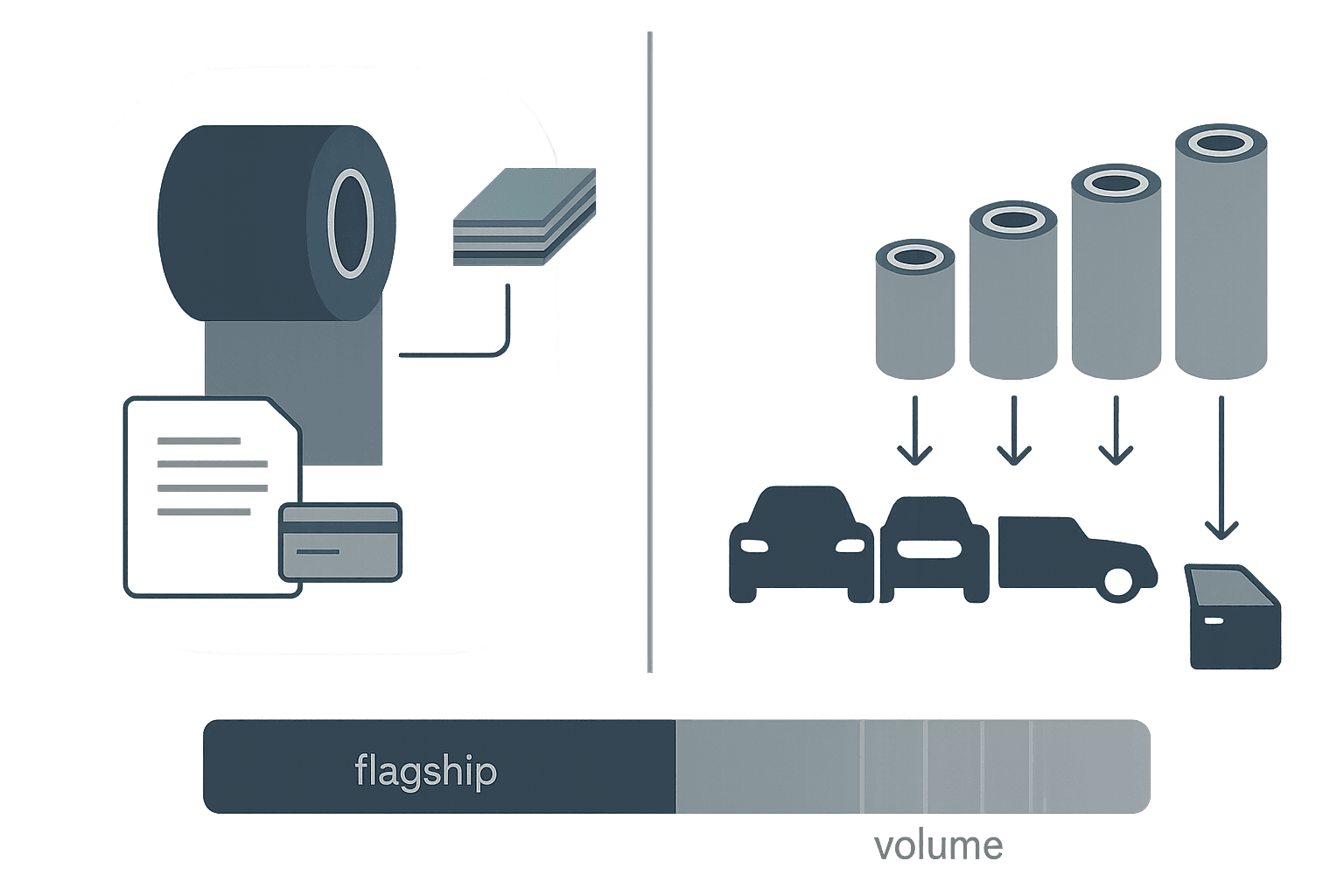
For shops and distributors, ceramic coating vs PPF is not only a consumer education topic. It is a sales ladder.
| Product | Role in shop revenue |
|---|---|
| Ceramic coating | Entry detailing upsell |
| Partial PPF | Converts price-sensitive buyers |
| Full front PPF | Core high-value protection package |
| Full car PPF | Premium ticket |
| Hydrophobic PPF | Modern premium film story |
| PPF plus coating | Best bundle for profit and customer satisfaction |
| Sample books | Help customers see gloss, clarity, matte and color options |
| Wholesale PPF rolls | Let installers protect margin and control supply |
This is where XPSHELL fits naturally.
XPSHELL can be positioned as a B2B film supply option for shops and distributors who want to compare premium hydrophobic PPF, build sample books, create Tesla PPF packages and protect installer margin through distributor pricing. The message should not be "cheap alternative." The stronger message is:
Compare premium hydrophobic PPF with sample rolls before choosing your retail package strategy.
XPSHELL CTA Section
Ceramic coating and PPF are not enemies. They are different layers in the same paint protection business.
For shops, PPF is the higher-ticket protection package. Ceramic coating is the maintenance and gloss upsell. Premium hydrophobic PPF connects both stories by offering impact protection plus easier cleaning behavior.
XPSHELL supplies clear PPF, matte PPF and color PPF rolls for installers, shops and distributors. Use sample rolls to compare optical clarity, hydrophobic behavior, adhesive performance, self-healing, stretch, orange peel, stain resistance and batch consistency before bulk ordering.
Want to compare premium hydrophobic PPF at distributor pricing? Request XPSHELL sample rolls.
Suggested Internal Links
| Anchor text | Target page |
|---|---|
| PPF Sample Books | Sample book / sample roll page |
| Buy PPF Direct from Manufacturer or Distributor | Manufacturer vs distributor guide |
| LLumar Valor vs Platinum | LLumar comparison page |
| LLumar Valor PPF Price | Valor price guide |
| 3M PPF Tesla Model Y | Tesla Model Y PPF page |
| XPEL Updates | XPEL updates and market trends page |
| Tesla PPF Packages | Tesla package guide |
| Ceramic Coating for PPF | Coating over PPF support page |
| Wholesale PPF Rolls | XPSHELL wholesale roll page |
FAQ
Is PPF and ceramic coating the same?
No. PPF and ceramic coating are not the same. PPF is a physical paint protection film installed over painted panels. Ceramic coating is a liquid surface coating used for gloss, slickness, water beading and easier cleaning.
What is the difference between ceramic coating and paint protection film?
The main difference is impact protection. Paint protection film gives a physical barrier against rock chips, scratches and abrasion. Ceramic coating improves surface behavior, gloss and cleaning, but it is not a strong rock chip protection layer.
PPF car vs ceramic coating: which is better?
PPF is better for rock chips, scratches, road debris and high-impact areas. Ceramic coating is better for gloss, water beading and easier maintenance. For premium protection, use PPF first and add ceramic coating if compatible.
Which is better for scratches, ceramic coating or PPF?
PPF is better for scratches caused by road debris, light abrasion and contact on covered areas. Ceramic coating can help reduce washing friction and improve slickness, but it is not a physical scratch protection film.
Is ceramic coating vs PPF cost very different?
Yes. Ceramic coating usually has a lower entry cost. PPF costs more because it requires film material, cutting, installation labor, panel preparation and edge finishing. Full front PPF and full car PPF are higher-ticket services.
Can ceramic coating be applied over PPF?
Yes, ceramic coating can be applied over compatible PPF. The coating should match the film surface and installer process. Some premium PPF lines already include hydrophobic or ceramic-like topcoats, so extra coating may not always be necessary.
Does ceramic coating prevent rock chips?
No. Ceramic coating is not the right solution for rock chips. For rock chip protection, PPF is the better choice because it creates a physical layer over the paint.
Should Tesla owners choose PPF or ceramic coating first?
Tesla owners should usually choose PPF first for high-impact areas such as the front bumper, hood, fenders, mirrors, rocker panels, rear doors and rear fenders. Ceramic coating can be added later for easier cleaning and gloss.
Is premium hydrophobic PPF worth it?
Premium hydrophobic PPF can be worth it because it combines impact protection with easier cleaning behavior. It is especially useful for shops that want to sell a higher-value package without always adding a separate coating step.
How should shops sell ceramic coating and PPF together?
Shops should explain them as different layers: PPF for impact protection, ceramic coating for surface maintenance. For premium customers, sell PPF plus coating. For modern film buyers, introduce hydrophobic PPF as a strong middle option.
References
[1] 3M - Ceramic Coating 39901 Technical Datahttps://multimedia.3m.com/mws/media/1990834O/3m-ceramic-coating-tds-39901.pdf
[2] 3M - Scotchgard Paint Protection Film Pro Series 200https://www.3m.com/3M/en_US/p/d/b5005352002/
[3] 3M - Paint Protection Film FAQhttps://multimedia.3m.com/mws/media/2237340O/faq-3m-paint-protection-film.pdf
[4] LLumar - Valor Paint Protection Filmhttps://llumar.com/en/paint-protection-film/valor/
[5] LLumar - Paint Protection Filmhttps://llumar.com/en/paint-protection-film/
[6] Tesla Shop - Model Y Paint Protection Filmhttps://shop.tesla.com/product/model-y-paint-protection-film
[7] Tesla Model Y Owner's Manual - Cleaninghttps://www.tesla.com/ownersmanual/modely/en_us/GUID-65384C1F-86F2-44E8-A8BC-8A12E7E00A40.html
[8] XPSHELL - Paint Protection Filmhttps://xpshell.com/products/paint-protection-film