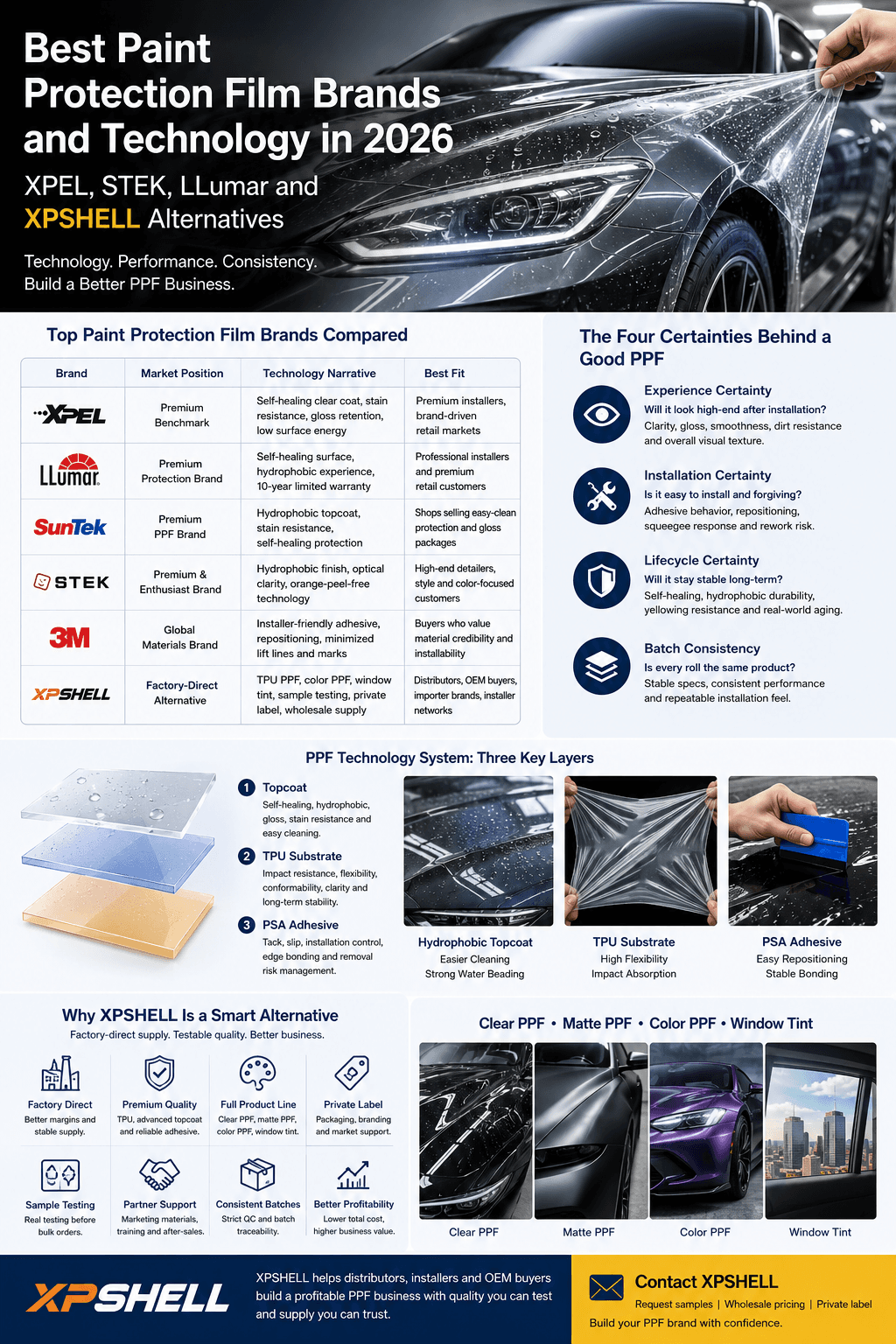
Best Paint Protection Film Brands and Technology in 2026: XPEL, STEK, LLumar and XPSHELL Alternatives
Choosing the best paint protection film brand is not just about asking which name is most famous.
That question is too simple.
A better question is:
Which PPF brand can deliver premium appearance, stable installation, long-term protection, predictable batch quality and a profitable business model?
For car owners, a famous brand reduces decision risk. For installers, the film must be easy to position, stretch, squeegee and finish. For distributors, the film must be stable enough to reorder, support dealers and protect local reputation. For private label buyers, the supplier must offer not only rolls, but also product structure, packaging options, sample testing and long-term supply consistency.
That is why searches such as “best PPF brands,” “XPEL alternative,” “STEK alternative,” “LLumar alternative,” “PPF manufacturer,” and “wholesale paint protection film” should not be answered with a simple ranking list.
PPF is both a material engineering system and a supply chain system.
The most important question is not only “which brand is best?”
The real question is:
Which system is most predictable for your market?
Top Paint Protection Film Brands Compared
The PPF market has several major reference brands. These brands matter because they define how customers understand quality, warranty, installation and premium pricing.
| Brand | Market Position | Technology Narrative | Best Fit | What Buyers Should Check |
|---|---|---|---|---|
| XPEL | Premium benchmark | Self-healing clear coat, stain resistance, gloss retention, low surface energy | Premium installers, Tesla owners, retail brand-driven markets | Dealer cost, local margin, installer network dependence |
| LLumar | Premium protection film brand | Self-healing surface, hydrophobic experience, warranty-backed product line | Professional installers and premium retail customers | Local dealer support, product availability, warranty terms |
| SunTek | Premium PPF and window film brand | Hydrophobic topcoat, stain resistance, self-healing PPF lines | Shops selling easy-clean protection and premium gloss packages | Product line differences by region |
| STEK | Premium and enthusiast-focused brand | Hydrophobic finish, optical clarity, orange-peel-free positioning, specialty finishes | High-end detailers, color and style-focused customers | Local support, price level, dealer structure |
| 3M | Global materials brand | Installer-friendly adhesive, repositioning, minimized lift lines, hydrophobic surface | Buyers who value material-brand credibility and installability | Exact product line and local installation experience |
| Avery Dennison | Recognized automotive film company | Strong reputation in vehicle films, wraps and graphics | Shops familiar with automotive films and wrap systems | PPF-specific adoption varies by market |
| PremiumShield | Professional PPF brand | Impact resistance, stain resistance and professional installation positioning | PPF shops and professional detailers | Regional awareness and support |
| XPSHELL | Factory-direct alternative | TPU PPF, color PPF, window tint, sample testing, private label, wholesale supply | Distributors, OEM buyers, importer brands, installer networks | Sample testing, spec confirmation, batch planning |
This is not a list designed to say one brand wins every market.
XPEL, LLumar, SunTek, STEK and 3M are strong premium references. They help buyers understand what premium PPF should look like. But XPSHELL belongs in a different position: not as a retail-famous legacy brand, but as a factory-direct alternative for professional buyers who want to test film performance, build a local product line and control their own margin structure.
Why the Best PPF Cannot Be Judged by Brand Alone
Most PPF articles talk about the same surface-level features:
- Self-healing
- Hydrophobic
- High gloss
- Anti-yellowing
- 8 mil thickness
- 10-year warranty
These words are useful, but they are not enough.
A poor film can still claim “self-healing.” A difficult-to-install film can still look glossy in a sample photo. A low-cost film can look premium at first but become hard to clean, dull, hazy or unstable after months of real driving.
A professional PPF buyer should judge film through four certainties.
The Four Certainties Behind a Good PPF
Experience Certainty: Will It Look High-End After Installation?
The first job of PPF is visual.
A good clear PPF should protect paint without making the car look covered. The film should maintain color depth, reflection clarity and a clean surface texture. On black paint, metallic paint and luxury vehicles, small differences in haze, orange peel and gloss become obvious.
Buyers should check:
- Optical clarity
- Gloss depth
- Haze level
- Orange peel texture
- Surface smoothness
- Dirt visibility
- Wash swirl visibility
- Edge cleanliness after installation
STEK DYNOshield is a good example of a brand using optical clarity as part of its premium story. Its official product positioning emphasizes hydrophobic properties, optical clarity and an orange-peel-free finish [4].
For XPSHELL, this means the product conversation should not only say “high gloss.” It should say: test the film on real panels, compare clarity under lighting, check dirt visibility after washing and evaluate whether the finish still looks premium after installation.
Installation Certainty: Is It Easy to Install and Forgiving?
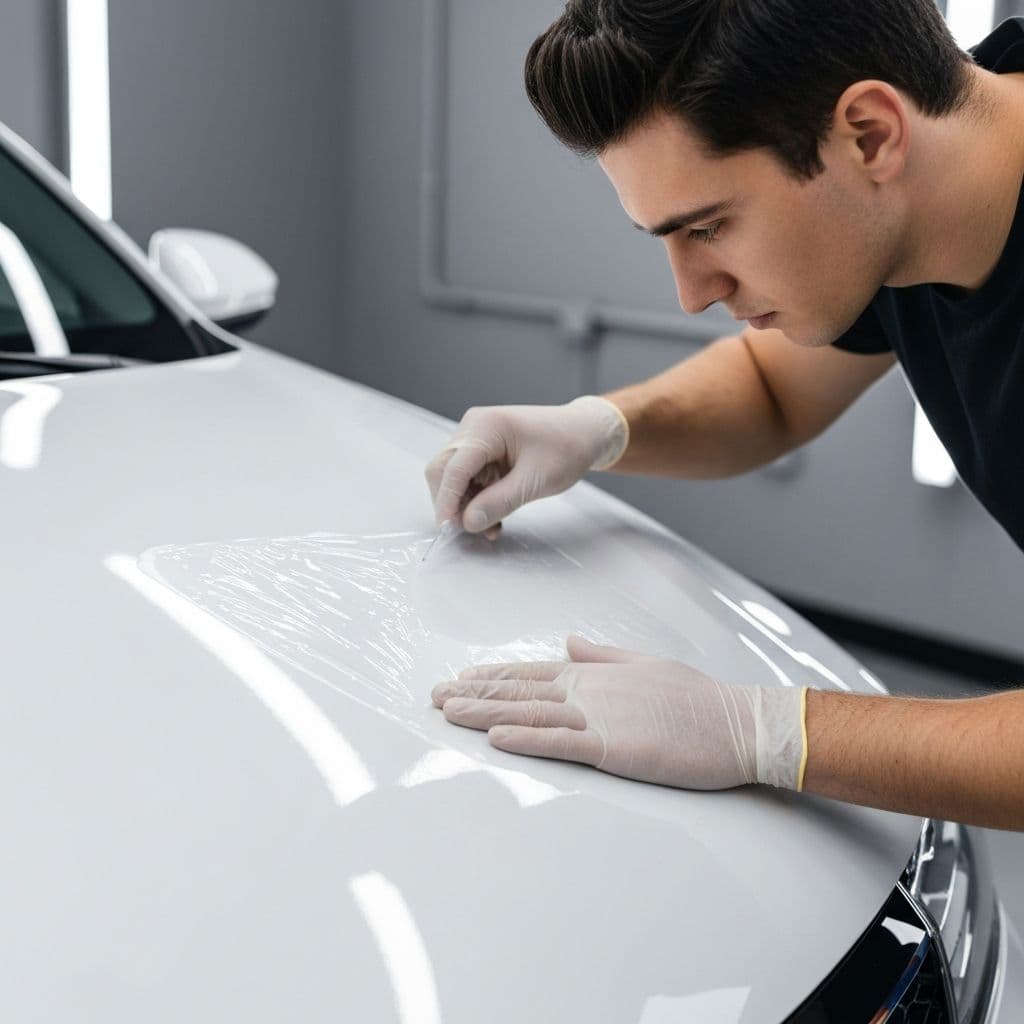
PPF quality is not only decided in the factory. It is also decided during installation.
A film that looks good but installs poorly creates hidden costs:
- Longer installation time
- More rework
- More glue marks
- More lift lines
- More edge complaints
- Lower installer confidence
- Lower dealer adoption
This is why adhesive behavior matters so much.
Eastman describes typical PPF as a transparent elastic urethane film with pressure-sensitive mounting adhesive, installed on smooth painted or plastic surfaces using a surfactant-based water solution or proprietary application gel [8]. This explains an important point: PPF installation is not magic. It depends on the interaction between the film, the adhesive and the installation fluid system.
A good PSA adhesive must perform across three stages.
Wet Application Stage
During wet installation, the adhesive must allow the installer to position the film, move it, squeegee water and avoid immediate aggressive biting.
If the adhesive grabs too quickly, the result may be:
- Harder repositioning
- Higher rework rate
- Water trapped under the film
- Silvering or water marks
- Stress lines on complex curves
- Poor installer experience
Curing Stage
After installation, the adhesive must build stable bonding.
If bonding is unstable, problems may appear weeks or months later:
- Edge lifting
- Dirt trapped at edges
- Shrinkage appearance
- Local bubbling
- Dealer complaints
- Warranty disputes
Removal Stage
PPF should also have a clear risk boundary when removed. Paint condition, repaint quality and damaged surfaces can affect removal risk. This is why a professional supplier must explain not only how the film installs, but also where the limits are.
3M Pro Series 200 is a useful technical reference because 3M emphasizes optimized adhesive for repositioning, minimizing lift lines and adhesive marks [9]. This shows that adhesive is not a minor detail. It directly affects installation efficiency and delivery reliability.
For XPSHELL, the key message should be:
A true factory-direct alternative must be tested not only for gloss, but also for installability, tack behavior, edge stability and rework risk.
Lifecycle Certainty: Will the Film Stay Stable Long-Term?
The most dangerous PPF failure is not immediate failure. It is short-term beauty followed by long-term decay.
A film may look good when freshly installed but later become:
- Dull
- Hard to clean
- Yellowed
- Stained
- Hazy
- Edge-lifted
- Dirty-looking
- Visually aged
This is where topcoat and TPU stability become important.
LLumar Platinum Gloss positions its film around a self-healing surface and hydrophobic performance with a 10-year limited warranty [2]. SunTek Reaction promotes a hydrophobic topcoat, stain resistance and premium self-healing protection [3]. XPEL ULTIMATE PLUS technical materials describe a low surface energy film designed to resist staining, offer environmental resistance and retain gloss, with a clear coat that allows scratches to heal over time [1].
These brand narratives show what premium brands are really selling: not only protection, but a long-term ownership experience.
For XPSHELL, the correct way to enter this conversation is not to make exaggerated claims. The better angle is:
XPSHELL helps buyers verify long-term experience through sample testing, product line clarity, installation feedback and repeat supply control.
Batch Consistency: Is Every Roll Truly the Same Product?
This is the most important point for B2B buyers.
Consumer articles often ignore batch consistency because a car owner may only install PPF once. But distributors, importers and installer networks buy repeatedly. They need every roll to behave predictably.
One batch difference can cause:
- Different installation feel
- Different tack behavior
- Different gloss
- Different haze
- Edge instability
- Dealer complaints
- Warranty pressure
- Lost trust in the local brand
For distributors, the best PPF is not simply the glossiest roll. It is the most predictable supply.
This is where factory-direct sourcing can be powerful if managed correctly. A supplier like XPSHELL must be evaluated by whether it can support repeatable specifications, batch control, sample verification, packaging consistency and after-sales communication.
The Technology System Behind PPF
PPF quality comes from a system. The three most important layers are:
- TPU substrate
- Topcoat
- PSA adhesive
Each layer controls a different part of the customer experience.
TPU Substrate: The Chassis of PPF Performance
TPU is the foundation of modern paint protection film.
If the topcoat is the skin and the adhesive is the delivery system, then TPU is the chassis.
TPU affects:
- Impact absorption
- Flexibility
- Conformability
- Clarity
- Haze
- Yellowing tendency
- Long-term stability
- Stretch behavior
- Installation stress
- Batch consistency
Lubrizol’s ESTANE TPU positioning emphasizes quality and consistency for efficient processing and crystal-clear, long-lasting PPF [7]. This shows why substrate selection is not a simple material label. It affects the film’s ability to remain clear, flexible and stable.
Good TPU Is About Balance
A common mistake is to judge TPU by one parameter only.
Thicker is not always better. Harder is not always better. Softer is not always better.
A good PPF substrate must balance:
- Protection and flexibility
- Stretch and memory
- Clarity and durability
- Softness and edge stability
- Impact resistance and installability
For installers, this balance decides whether the film fits complex curves smoothly. For distributors, it decides whether different rolls can deliver a similar result over time.
TPU Stability Affects Long-Term Appearance
Yellowing, haze and dullness are often blamed on weather or washing. But the material system sets the ceiling.
A stable TPU system helps the film maintain:
- Better transparency
- More predictable aging
- Cleaner long-term appearance
- More reliable stretch behavior
- Lower risk of visual decay
For XPSHELL, the technical discussion should emphasize that buyers should not only ask “what TPU is used?” They should ask:
Can the supplier deliver the same product repeatedly, with stable clarity, stretch and aging behavior?
Topcoat: The Layer That Decides Daily Experience
The topcoat is what the customer interacts with every day.
It affects:
- Gloss
- Smoothness
- Self-healing
- Hydrophobic behavior
- Stain resistance
- Wash swirl visibility
- Ease of cleaning
- Long-term premium feel
This is why premium brands spend so much effort talking about surface technology.
XPEL discusses low surface energy, stain resistance and gloss retention [1]. SunTek Reaction uses a hydrophobic topcoat as a key product story [3]. STEK highlights a nano-ceramic-infused topcoat for hydrophobic properties and optical clarity [4].
Self-Healing Is Not Magic
Self-healing does not mean every scratch disappears.
It mainly helps reduce the visibility of fine surface marks, light swirls and minor scratches when heat is applied or when the film is exposed to warm conditions. Deep cuts, punctures or severe deformation are not solved by a self-healing slogan.
This matters for sales.
If an installer promises “all scratches can disappear,” the customer may be impressed at first but disappointed later. Professional education should define what self-healing can and cannot do.
Hydrophobic Does Not Mean Maintenance-Free
Hydrophobic topcoats make the film easier to clean. They help reduce the effort needed to remove water, road film, insects and dirt.
But hydrophobicity is a surface state. It can be affected by:
- Dust
- Road grime
- Hard water
- Washing chemicals
- Poor maintenance
- Environmental contamination
A professional supplier should explain maintenance boundaries clearly.
For XPSHELL, the best angle is not only “hydrophobic topcoat.” The better message is:
Use hydrophobic performance as part of a complete ownership experience, but educate dealers on cleaning, maintenance and realistic customer expectations.
PSA Adhesive: The Hidden Layer That Decides Profit
Many buyers look at film thickness, gloss and brand name first.
But installers know the truth: adhesive decides whether the job is smooth or painful.
A poor adhesive can destroy profit even if the film itself looks good.
The adhesive controls:
- Initial tack
- Slip behavior
- Repositioning
- Squeegee response
- Water evacuation
- Edge bonding
- Lift line risk
- Glue mark risk
- Removal risk
3M’s official product description for Scotchgard Paint Protection Film Pro Series 200 specifically mentions optimized adhesive for repositioning, minimizing lift lines and adhesive marks [9]. This is one of the clearest examples of a major brand treating adhesive as a commercial advantage.
For B2B buyers, this is critical.
If a roll saves money but increases installation time by 20-30 percent, the material saving may disappear. If the adhesive causes edge problems, the after-sales cost may be higher than the original margin.
For XPSHELL, the PSA discussion should be central:
A factory-direct PPF alternative must prove that its adhesive is not only sticky, but controllable.
Why XPEL, LLumar, STEK and SunTek Alternatives Exist
Premium brands are expensive because they sell more than film.
Their price often includes:
- Brand trust
- Dealer system
- Warranty structure
- Installer network
- Product education
- Marketing materials
- Channel margin
- Retail confidence
These things have value.
But they also create a price structure that may not suit every market.
A distributor may respect XPEL but still need a better-margin alternative. An installer may like STEK but want more flexible sourcing. A private label buyer may admire LLumar’s product structure but want to build a local brand. A wholesaler may need clear PPF, matte PPF, color PPF and window tint under one supply program.
That is why “alternative” does not necessarily mean cheap.
A true alternative should mean:
- Testable product quality
- Clear technical positioning
- Stable supply
- Better margin
- Private label flexibility
- Dealer support potential
- Repeatable installation feedback
- Executable after-sales rules
This is the space where XPSHELL should be positioned.
XPSHELL’s Role: Factory-Direct Alternative, Not Cheap Substitute
XPSHELL should not be presented as “the same as XPEL” or “better than every premium brand.”
That is not the strongest claim.
The stronger and more credible positioning is:
XPSHELL is a factory-direct PPF, color PPF and window tint supplier for distributors, OEM buyers and private label programs that want to build a testable, scalable and margin-friendly film business.
This positioning works because it does not fight premium brands on retail fame. It competes on supply-chain control, sample testing, product mix and B2B business structure.
What XPSHELL Can Help Buyers Build
| Product Line | Buyer Use Case | Business Value |
|---|---|---|
| Clear gloss PPF | Mainstream paint protection packages | Core volume product for installers |
| Premium gloss PPF | Luxury vehicles and high-end shops | Higher ticket and better margin |
| Matte PPF | Tesla, luxury cars, stealth-style packages | Premium styling and protection |
| Satin PPF | Soft luxury finish and personalization | Differentiation from standard gloss PPF |
| Color PPF | Color change plus TPU protection | Higher-margin visual upgrade |
| Window tint | Heat rejection, privacy, UV protection | Cross-sell with PPF packages |
| Private label packaging | Distributor and local brand development | Long-term channel control |
| Sample books | Dealer selling tools | Faster customer education and conversion |
This is the business logic.
XPSHELL is not only selling film rolls. It is helping distributors build a product system.
How to Compare a Premium Brand and a Factory-Direct Alternative
A professional buyer should not choose by slogans.
Use an evidence chain.
1. Brand Narrative
Ask whether the brand or supplier can clearly explain:
- What product line is premium?
- What product line is entry-level?
- Which film is best for gloss?
- Which film is best for matte?
- Which film is best for color PPF?
- What is the warranty boundary?
- What is the recommended use case?
Premium brands are usually strong here. A factory-direct alternative must also be able to explain its product system clearly.
2. Technical Evidence
Check the three-layer system:
- TPU substrate
- Topcoat
- PSA adhesive
Do not stop at “8 mil,” “self-healing,” or “hydrophobic.”
Ask:
- How does the film install?
- How does the topcoat age?
- How stable is the adhesive?
- How consistent are batches?
- What happens under heat, humidity and washing?
- Can the supplier explain real-world limits?
3. Installation Feedback
A good alternative must be tested by installers.
Test:
- Hood installation
- Bumper installation
- Mirror installation
- Edge wrapping
- Stretch recovery
- Glue marks
- Lift lines
- Water evacuation
- Post-install inspection
One good sample is not enough. The feedback should be repeatable.
4. Batch Control
For distributors, this is the real test.
Ask:
- Are roll specs consistent?
- Are batch numbers traceable?
- Can the supplier reproduce the same film?
- Is packaging consistent?
- How are quality issues reviewed?
- Can trial orders scale into monthly orders?
A supplier that cannot manage batch consistency cannot support a real distributor business.
5. After-Sales Rules
A professional PPF supplier should define:
- What counts as product defect?
- What counts as installation error?
- What counts as paint condition risk?
- What photos or videos are needed?
- How are claims reviewed?
- How is compensation handled?
- How are dealers supported?
This is where serious suppliers separate themselves from low-end exporters.
PPF Cost: Why Brand Price and Business Cost Are Different
Retail customers usually think PPF cost means installation price.
Professional buyers should think in terms of business cost.
| Cost Type | Retail Customer View | Distributor or Installer View |
|---|---|---|
| Film price | Part of the installation quote | Roll cost, landed cost, inventory pressure |
| Brand premium | Trust and confidence | Easier selling but lower margin |
| Installation labor | Included in total price | Time, technician skill, rework risk |
| Adhesive behavior | Usually invisible | Directly affects profit and complaints |
| Topcoat performance | Shine and easy cleaning | Long-term satisfaction and warranty risk |
| Batch consistency | Not considered | Core to repeat orders and dealer trust |
| Packaging | Not important | Important for private label and local brand building |
| Warranty | Peace of mind | Claim process and cost exposure |
A low-cost film is not always profitable. A premium brand is not always commercially suitable.
The best choice depends on the market, selling price, installer skill, customer expectation and supply model.
Best PPF Choice by Buyer Type
| Buyer Type | Main Concern | Best-Fit Direction |
|---|---|---|
| Individual car owner | Trust, installer skill, warranty | XPEL, LLumar, SunTek, STEK, 3M or a strong local installer |
| Tesla owner | Full front, full body, paint protection education | Premium brands or tested alternatives with strong installer support |
| Professional installer | Installation feel, low rework, clear finish | Test multiple brands before switching |
| Distributor | Margin, repeat supply, product mix, dealer support | Compare premium brands with XPSHELL-style factory-direct supply |
| Private label buyer | Packaging, product structure, supply control | XPSHELL or OEM-ready manufacturer |
| Color PPF seller | Finish range, color samples, styling story | XPSHELL color PPF or specialty color PPF supplier |
Final Recommendation: How to Choose the Best PPF Brand
If your customer is asking for a famous retail name, XPEL, LLumar, SunTek, STEK and 3M are strong brands to compare.
If you are building a PPF business, you need to go deeper.
You need to evaluate:
- Brand trust
- TPU substrate
- Topcoat durability
- PSA adhesive behavior
- Installation workability
- Long-term stability
- Batch consistency
- Warranty logic
- Dealer support
- Private label potential
- Wholesale margin
This is why XPSHELL deserves a clear position in the comparison.
XPSHELL is not simply a cheap alternative. It is better understood as a factory-direct alternative for distributors, OEM buyers and private label programs that want to test film quality, build a local product line and control supply-chain economics.
The best PPF is not only advertised. It is verified, installed, repeated and supported.
For professional buyers, the winning product is not just the one with the loudest brand name. It is the one that can be sold, installed, reordered and trusted again.
FAQ
What is the best paint protection film brand in 2026?
There is no single best PPF brand for every buyer. XPEL, LLumar, SunTek, STEK and 3M are strong premium references. XPSHELL is better positioned as a factory-direct alternative for distributors, OEM buyers and private label programs.
Is XPEL the best PPF brand?
XPEL is one of the strongest premium benchmarks because of its brand recognition, self-healing PPF positioning and installer network. However, professional buyers should also compare adhesive behavior, topcoat durability, installation feedback, batch consistency and business margin.
What makes a good XPEL alternative?
A good XPEL alternative should not only be cheaper. It should provide clear product positioning, stable TPU substrate, reliable topcoat performance, controllable adhesive behavior, repeatable installation results, batch consistency and executable after-sales rules.
Is XPSHELL an XPEL alternative?
Yes, XPSHELL can be positioned as a factory-direct XPEL alternative for B2B buyers. It is not positioned as identical to XPEL. Its value is in sample testing, wholesale supply, private label packaging, color PPF, window tint and distributor support.
Why is PSA adhesive important in PPF?
PSA adhesive affects installation time, repositioning, water evacuation, lift lines, glue marks, edge stability and removal risk. For installers and distributors, adhesive performance directly affects profit and after-sales cost.
Why does TPU substrate matter in paint protection film?
TPU substrate affects flexibility, impact resistance, clarity, haze, yellowing tendency, stretch behavior and long-term stability. A stable TPU system helps PPF remain clear, flexible and predictable over time.
Is hydrophobic PPF maintenance-free?
No. Hydrophobic PPF is easier to clean, but it is not maintenance-free. Dust, road film, hard water, chemicals and poor washing habits can affect hydrophobic performance over time.
Is color PPF better than vinyl wrap?
Color PPF and vinyl wrap serve different purposes. Vinyl wrap mainly changes vehicle appearance. Color PPF combines styling with TPU-based paint protection, making it useful for higher-ticket styling and protection packages.
What should distributors test before buying wholesale PPF?
Distributors should test gloss, haze, orange peel, adhesive tack, slip behavior, stretch, edge stability, hydrophobic effect, self-healing, yellowing resistance, packaging consistency and batch repeatability.
CTA
Looking for a factory-direct PPF alternative for your market?
XPSHELL supplies clear paint protection film, color PPF and window tint for distributors, OEM buyers and private label programs.
Request samples, compare installation performance, test topcoat behavior, confirm packaging options and build a PPF product line around stable quality, better margin and repeatable supply.
Contact XPSHELL to request sample rolls, wholesale pricing and private label options.
References
[1] XPEL ULTIMATE PLUS Technical Data Sheet(https://www.xpel.com/web-assets/downloads/XPEL-ULTIMATE-PLUS-TDS-82019-V1-1.pdf)
[2] LLumar Platinum Gloss Paint Protection Film(https://llumar.com/na/en/automotive/paint-protection-film/platinum-gloss/)
[3] SunTek Reaction Paint Protection Film(https://suntekfilms.com/na/en/paint-protection-film/reaction/)
[4] STEK DYNOshield Hydrophobic Paint Protection Film(https://www.stek-usa.com/paint-protection-film/dynoshield/)
[5] 3M Scotchgard Paint Protection Film Pro Series 200(https://www.3m.com/3M/en_US/p/d/b5005352002/)
[6] 3M Paint Protection Film FAQ(https://multimedia.3m.com/mws/media/2237340O/faq-3m-paint-protection-film.pdf)
[7] Lubrizol ESTANE TPU Solutions for Paint Protection Film(https://www.lubrizol.com/industries/transportation-machinery-and-equipment/automotive-materials/paint-protection-film)
[8] Eastman Urethane Paint Protection Film with Pressure-Sensitive Adhesive(https://www.eastman.com/en/products/product-detail/71100690/films-urethane-paint-protection-with-pressure-sensitive-adhesive)
[9] XPSHELL PPF Manufacturer and Window Tint Supplier(https://xpshell.com/)
[10] XPSHELL Color Paint Protection Film(https://xpshell.com/products/color-paint-protection-film)