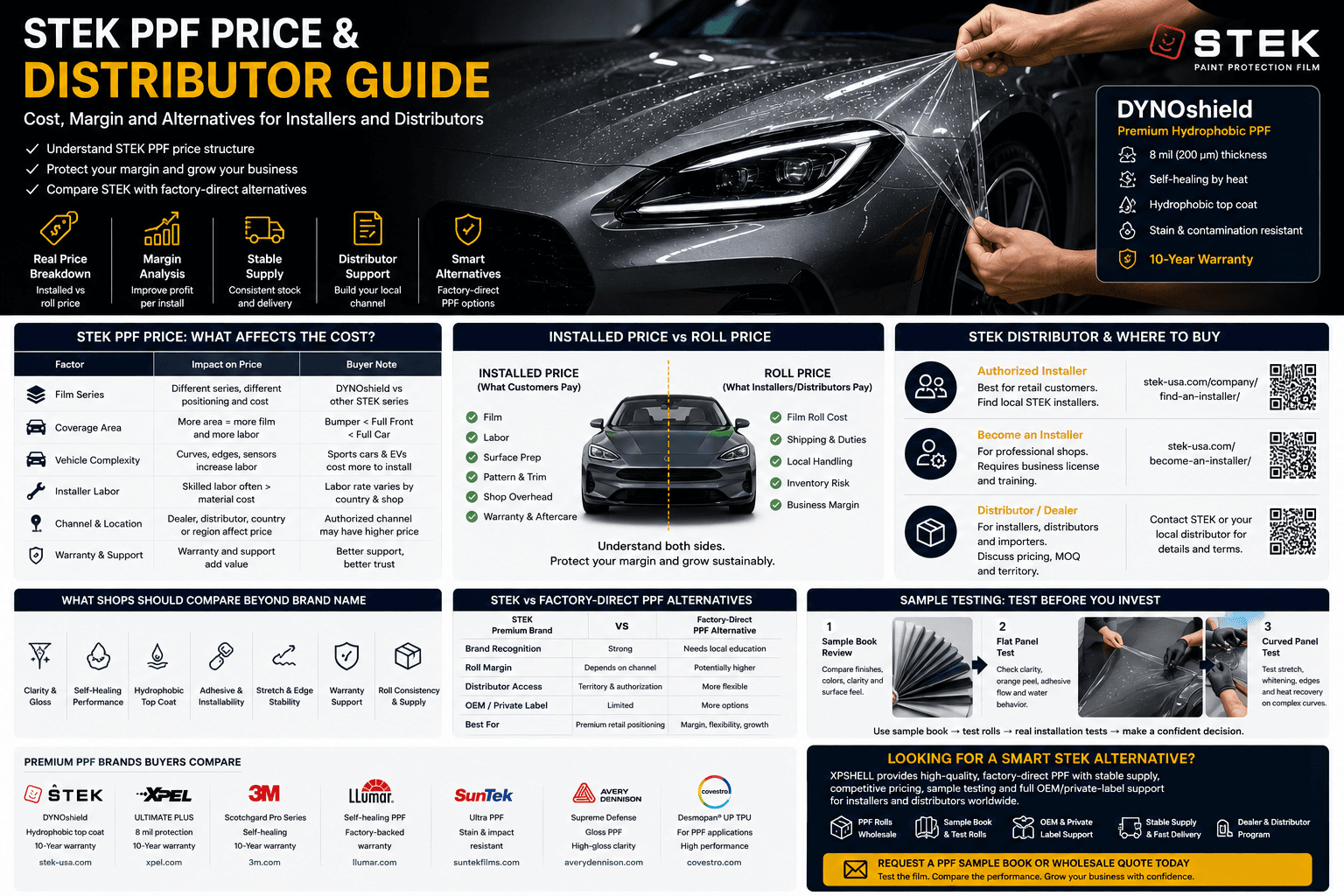
STEK PPF Price: Quick Answer
STEK PPF price is not a single fixed number.
For car owners, the final installed price depends on the vehicle, coverage area, local labor rate, installer skill, pattern work, edge wrapping, surface preparation and warranty support.
For installers and distributors, STEK PPF cost means something different. They are not only asking, "How much does STEK PPF cost installed?" They are asking:
- What is the roll cost?
- What is the landed cost after shipping and duties?
- What margin can the shop keep?
- Can the film be reordered consistently?
- Is there a distributor or dealer channel in my country?
- Can I get samples before bulk orders?
- Can I build a second product line beside a premium brand?
- Can I use a factory-direct PPF alternative for selected customer segments?
That is why this guide separates retail installed price, wholesale roll price, distributor margin and alternative supply models.
For professional buyers, the real question is not only whether STEK is good. The better question is:
Can this film supply model help my shop or distribution business sell, install, reorder and profit consistently?
Why STEK PPF Cost Varies by Market
STEK PPF cost varies because paint protection film is both a product and a service.
A customer buying a bumper package, full front package or full car PPF package is not paying only for film. The installed price also includes labor, pattern software, surface preparation, trimming, stretching, edge finishing, shop overhead, warranty risk and aftercare.
A distributor or installer buying rolls is looking at a different cost structure.
| Cost Factor | Why It Changes the Price | Buyer Note |
|---|---|---|
| Film series | Different STEK product lines have different positioning | Compare DYNOshield, DYNOmatte, fashion films and thicker films separately |
| Coverage area | Bumper, full front, track package and full car packages use different film quantities | Never compare a bumper quote with a full car quote |
| Vehicle complexity | Curves, bumpers, mirrors, sensors and edges affect labor | Tesla, sports cars and luxury cars may cost more |
| Installer labor | Skilled PPF labor often exceeds material cost in retail jobs | Installed price is not the same as roll price |
| Dealer channel | Authorized channels may include brand trust, training and warranty support | Useful for retail confidence |
| Bulk supply | Roll pricing depends on quantity, source and terms | Important for distributors and repeat buyers |
| Warranty expectation | Warranty support affects customer confidence and shop responsibility | Ask what is covered and who handles claims |
| Local market | Labor rates and customer willingness to pay differ by country | Compare local package prices, not random online quotes |
This is why professional buyers should be careful with simple statements such as "STEK costs X per roll" or "STEK costs X for a full car."
The number depends on country, installer, channel, vehicle, coverage and buying model.
STEK DYNOshield: What Buyers Usually Compare
STEK DYNOshield is one of the most searched STEK paint protection film products. Buyers often compare it with XPEL, 3M, LLumar, SunTek and other premium PPF options.
According to STEK's official DYNOshield product information, DYNOshield is an 8 mil glossy paint protection film with hydrophobic properties, anti-contamination performance, stain resistance and self-healing by heat or hot water. STEK also states that DYNOshield is warrantied for 10 years against delamination, yellowing, bubbling and cracking.
For car owners, these features support premium protection and finish quality.
For installers and distributors, these same features must be tested in real installation conditions.
| Feature | Why It Matters | What Buyers Should Test |
|---|---|---|
| Gloss and clarity | Affects how close the film looks to original paint | Install on black paint and metallic paint |
| Hydrophobic top coat | Helps water behavior and cleaning experience | Test water beading after washing |
| Self-healing | Helps light surface marks recover with heat | Test light scratches, not deep cuts |
| Stain resistance | Reduces risk from road grime and contaminants | Test cleaning behavior after exposure |
| Orange peel level | Affects premium visual finish | Compare under strong shop lighting |
| Adhesive behavior | Affects repositioning, edges and installer speed | Test bumper curves and mirror caps |
| Stretch and recovery | Affects full front and complex panels | Check whitening, glue marks and distortion |
| Warranty support | Builds customer confidence | Confirm who handles claims and registration |
A STEK PPF review should not only ask whether DYNOshield looks good on a sample card. It should ask whether the film installs well, sells well, reorders reliably and protects shop margin.
STEK DYNOshield vs XPEL
Many buyers compare STEK DYNOshield vs XPEL because both are premium PPF options with strong brand recognition.
XPEL is often associated with a broad installer network and retail demand. STEK is often compared for its hydrophobic top coat, gloss, clarity and wider visual/fashion film positioning.
But for professional buyers, the better comparison is not only brand vs brand.
A useful STEK vs XPEL comparison should include:
| Comparison Point | Why It Matters |
|---|---|
| Film thickness and structure | Affects protection positioning and install feel |
| Top coat behavior | Affects gloss, cleaning, stain resistance and hydrophobicity |
| Adhesive behavior | Affects speed, repositioning and edge stability |
| Orange peel and clarity | Affects premium appearance on dark paint |
| Warranty and claim process | Affects shop risk and customer trust |
| Authorized installer support | Affects retail confidence |
| Roll cost and landed cost | Affects shop margin |
| Distributor access | Affects local supply and growth |
| Private-label flexibility | Affects long-term brand control |
For a car owner, a famous brand may be enough.
For an installer or distributor, the business model matters just as much as the product name.
Installed Price vs Roll Price
One of the biggest mistakes in STEK PPF price research is mixing installed price with roll price.
They are not the same thing.
| Price Type | Who Cares Most | What It Includes |
|---|---|---|
| Installed price | Car owners | Film, labor, prep, pattern work, installation, warranty support and shop overhead |
| Roll price | Installers and distributors | Material supply cost before installation labor |
| Landed cost | Importers and wholesalers | Roll cost plus shipping, duties, local handling and inventory risk |
| Dealer price | Authorized channel buyers | Brand channel pricing, terms and support |
| Factory-direct cost | Alternative supply buyers | Direct supply, MOQ, OEM options and sample testing terms |
A retail customer may ask, "How much does STEK PPF cost for my car?"
An installer should ask:
- What is the roll cost?
- How much film is wasted per job?
- How many hours does installation take?
- How much can my local customer pay?
- What is the warranty risk?
- Can I reorder the same film consistently?
- Can I build a second package with a factory-direct alternative?
A distributor should ask:
- What is my landed cost?
- What is my wholesale margin?
- Can I support local installers with stable stock?
- Can I offer sample books and product training?
- Can I build a private-label program?
- Can I avoid depending on only one premium channel?
The installed price tells you what the customer pays.
The roll price tells you part of your cost.
The margin comes from understanding both.
STEK Distributor and Where-to-Buy Options
For retail customers, the safest way to buy STEK PPF is usually through an authorized installer or official installer locator. STEK provides an installer locator to help customers find local Authorized or Black Label STEK installers.
For installers, STEK also has a become an installer path. STEK's official information says authorized installer access requires a business license and professional-level use of its films.
For distributors and importers, the question "where to buy STEK PPF" becomes more complex.
They should ask:
- Is there an official distributor in my country?
- Can I buy rolls directly?
- Can I resell rolls legally within my market?
- Is warranty support available locally?
- Can I become an authorized installer or distributor?
- Are territory rules involved?
- Can I get stable supply during peak season?
- Is the pricing structure suitable for wholesale margin?
For professional buyers, "where to buy STEK PPF" is not only a purchase question. It is a channel question.
If the channel is controlled, the brand may provide retail trust but limit pricing flexibility.
If the channel is flexible, the buyer may have more room to build local margin, but may need to invest more in education, samples and dealer support.
What Shops Should Compare Beyond Brand Name
STEK is a strong brand, but brand name alone does not complete a professional purchasing decision.
Installers and distributors should compare:
| Evaluation Area | Why It Matters |
|---|---|
| Film structure | TPU, adhesive and top coat determine real performance |
| Installation behavior | Stretch, tack, repositioning and edge control affect labor cost |
| Visual finish | Gloss, clarity and orange peel affect customer satisfaction |
| Hydrophobic behavior | Influences cleaning experience and perceived quality |
| Self-healing | Helps explain premium value to customers |
| Warranty terms | Affects customer trust and after-sales responsibility |
| Roll consistency | Reduces rework and installer complaints |
| Supply stability | Prevents stockouts during peak season |
| Packaging support | Helps distributors and private-label buyers |
| Margin structure | Determines whether the product line is profitable |
This is also why external competitor references matter.
3M's Scotchgard Paint Protection Film Pro Series 200 highlights optimized adhesive for repositioning, minimized lift lines and adhesive marks, hydrophobic features and stretch for bulk installations. LLumar highlights self-healing films, factory-backed warranties and dealer support. SunTek Ultra emphasizes protection against stains, rocks and road debris with a 10-year limited warranty. Avery Dennison highlights conformability, adhesive tack, stain and impact resistance, transparency and warranty.
These examples show that premium PPF competition is not only about brand awareness. It is about installability, finish, warranty, coating behavior and business support.
For B2B buyers, that leads to one practical conclusion:
A good STEK alternative should not simply be cheaper. It should be testable, installable, reorderable and profitable.
STEK vs Factory-Direct PPF Alternatives
A factory-direct PPF alternative may make sense when the buyer is building a business model, not only buying a famous logo.
STEK can be a strong premium option for shops that benefit from brand recognition and authorized installer positioning.
A factory-direct alternative may be attractive when the buyer needs:
- Better project margin
- Flexible supply terms
- Sample books and test rolls
- Private-label packaging
- Distributor pricing
- Local dealer development
- Multiple finish options
- More control over product positioning
| Comparison Point | STEK-Type Premium Brand | Factory-Direct PPF Alternative |
|---|---|---|
| Consumer recognition | Strong in premium markets | Needs local education |
| Installer trust | Supported by brand and network | Built through shop testing and local reputation |
| Roll margin | Depends on channel | Potentially more flexible |
| Distributor access | May depend on territory and authorization | More negotiable |
| OEM packaging | Usually limited | More flexible |
| Sample testing | Depends on channel access | Can be sample-book and test-roll driven |
| Supply control | Brand-channel dependent | More direct communication |
| Best for | Premium retail positioning | Installers, distributors and private-label buyers |
This does not mean installers should stop using STEK.
A better strategy may be a portfolio strategy:
- Use STEK for premium customers who ask for it directly.
- Use a factory-direct PPF alternative for price-sensitive customers.
- Use a private-label product line for local dealer development.
- Use sample books and test rolls to educate installers and customers.
- Use distributor pricing to build wholesale margin.
XPSHELL supports installers and distributors who want to compare paint protection film rolls, sample testing and factory-direct PPF supply before committing to bulk orders.
Sample Testing Before Switching Film Supplier
Installers should not switch PPF suppliers based only on price.
A low roll cost can become expensive if the film creates lifting, glue marks, yellowing, staining, excessive orange peel, poor stretch behavior or customer complaints.
Before buying in bulk, test the film in three stages.
Stage 1: Sample Book Review
Use a PPF sample book to compare:
- Gloss
- Matte finish
- Black PPF
- Color PPF
- Surface feel
- Visual clarity
- Sales presentation value
This helps with customer-facing comparison, but it is not enough for technical evaluation.
Stage 2: Flat Panel Test
Install the film on a hood, fender or painted test panel.
Check:
- Clarity
- Orange peel
- Adhesive flow
- Squeegee marks
- Water behavior
- Surface recovery
- Dirt and cleaning behavior
This gives a better view of how the film looks after installation.
Stage 3: Curved Panel Test
Install the film on a bumper corner, mirror cap or complex curve.
Check:
- Stretch feel
- Whitening
- Glue marks
- Edge lift
- Repositioning tolerance
- Heat response
- Installer feedback after 24 to 72 hours
This is where many films reveal their real installation behavior.
A distributor should also test more than one roll if possible. One good sample does not prove batch consistency.
XPSHELL as a STEK Alternative for Distributors
XPSHELL is positioned as a factory-direct PPF option for installers, distributors, importers and private-label buyers.
It is not positioned as a consumer-facing replacement for STEK. Instead, it is designed for professional buyers who want to test film performance, supply flexibility, sample support and margin structure before choosing a long-term supplier.
XPSHELL can support buyers who need:
- Paint protection film rolls
- Sample books
- Test rolls
- Gloss, matte, black and color PPF options
- Distributor pricing discussion
- OEM or private-label packaging
- Bulk supply support
- Dealer-facing product positioning
- Repeat supply planning
For distributors, XPSHELL can also support dealer and distributor program discussions.
For private-label buyers, XPSHELL can support OEM and private-label PPF options, including packaging, roll labels, sample books, warranty cards and dealer materials.
The practical approach is simple:
Do not choose only by brand name. Test the film, compare the cost structure, evaluate supply stability and then decide whether a factory-direct alternative fits your market.
Final Thoughts
STEK is a strong premium PPF brand, especially for buyers who value DYNOshield, hydrophobic top coat behavior, visual clarity, self-healing performance and authorized installer confidence.
But installers, distributors and private-label buyers need to compare more than the logo.
They need to understand installed price vs roll price, local channel structure, landed cost, sample testing, supply stability, OEM flexibility, dealer support and margin.
For some shops, STEK may remain the premium retail option.
For other buyers, a factory-direct PPF alternative can become a second product line, distributor opportunity or private-label growth path.
The best strategy is not to guess.
Compare samples. Test real panels. Review warranty logic. Calculate roll margin. Evaluate reorder stability. Then decide which PPF supply model supports your business.
FAQ
What is the average STEK PPF price?
There is no single average STEK PPF price for every country, vehicle and installer. The price depends on coverage area, vehicle complexity, local labor rate, installer skill, channel structure and warranty support.
Why does STEK PPF cost vary so much?
STEK PPF cost varies because installed PPF includes more than film. It includes surface preparation, pattern work, labor, trimming, edge wrapping, shop overhead, warranty responsibility and local market pricing.
What is STEK DYNOshield PPF?
STEK DYNOshield is a premium glossy paint protection film. STEK describes DYNOshield as 8 mils thick, hydrophobic, anti-contamination, stain resistant and self-healing by heat or hot water.
Is STEK DYNOshield better than XPEL?
STEK DYNOshield vs XPEL depends on the buyer's priorities. Some customers value XPEL's brand recognition and installer network. Others compare STEK for hydrophobic top coat, gloss and product positioning. Installers should test clarity, adhesive behavior, stretch, edge stability, warranty support and margin before deciding.
Where to buy STEK PPF?
Retail customers should use an authorized installer or official locator. Installers and distributors should contact STEK or local channels to understand availability, training, dealer access, territory rules and supply terms.
Can I buy STEK PPF rolls directly?
That depends on your market, buyer status and local channel rules. Professional buyers should confirm whether they can buy rolls, resell rolls, receive warranty support and access authorized installer or distributor terms.
What is a STEK distributor?
A STEK distributor is a channel partner or supplier that helps make STEK products available to installers or markets. Terms, territory and access can vary by region, so buyers should confirm local channel rules directly.
Is STEK PPF worth it?
STEK PPF can be worth it for customers who value premium film positioning, hydrophobic top coat behavior, self-healing performance and authorized installer support. For installers and distributors, the answer also depends on margin, roll cost, supply stability and customer demand.
What should installers compare before switching from STEK?
Installers should compare gloss, clarity, orange peel, adhesive behavior, stretch, edge stability, hydrophobic behavior, self-healing, warranty risk, roll consistency and reorder stability.
What is a STEK alternative?
A STEK alternative is another paint protection film option that buyers compare against STEK. For installers and distributors, this often means a factory-direct PPF, private-label PPF or another brand with different supply, pricing or OEM flexibility.
Is factory-direct PPF lower quality than STEK?
Not necessarily. Factory-direct PPF should be judged by testing. Installers should test real panels, check installation behavior and compare roll consistency before buying in bulk.
Can distributors use both STEK and a factory-direct alternative?
Yes. Some distributors or shops may use a portfolio strategy. STEK can serve premium branded demand, while a factory-direct PPF alternative can serve price-sensitive customers, local dealer programs or private-label opportunities.
Reference Logic
These references are used to support the article's main arguments, not just to add external links.
STEK sources support the factual boundary: DYNOshield specifications, 8 mil thickness, hydrophobic behavior, stain resistance, self-healing, warranty, installer locator and become-installer channel logic.
XPEL, 3M, LLumar, SunTek and Avery Dennison support the comparison framework: premium PPF brands commonly compete around protection, finish quality, hydrophobic or easy-clean top coats, self-healing, warranty, adhesive behavior and installer confidence.
Covestro supports the material-level argument: PPF is also a TPU, coating, adhesive and supply-chain decision, not only a brand decision.
References
[1] STEK USA - DYNOshield Hydrophobic Paint Protection Filmhttps://www.stek-usa.com/paint-protection-film/dynoshield/
[2] STEK USA - Clear Bra Paint Protection Filmhttps://www.stek-usa.com/paint-protection-film/
[3] STEK USA - Find a Local Installerhttps://www.stek-usa.com/company/find-an-installer/
[4] STEK USA - Become an Installerhttps://www.stek-usa.com/become-an-installer/
[5] XPEL - ULTIMATE PLUS Paint Protection Filmhttps://www.xpel.com/products/ultimate-plus
[6] 3M - Scotchgard Paint Protection Film Pro Series 200https://www.3m.com/3M/en_US/p/d/b5005352002/
[7] LLumar - Paint Protection Filmhttps://llumar.com/en/paint-protection-film/
[8] SunTek - Ultra Paint Protection Filmhttps://suntekfilms.com/na/en/paint-protection-film/ultra/
[9] Avery Dennison - Supreme Defense Gloss Paint Protection Filmhttps://graphics.averydennison.com/en/home/graphics-products/paint-protection-film/supreme-defense-gloss-film.html
[10] Covestro - Desmopan UP TPU Series for Paint Protection Filmhttps://www.covestro.com/press/covestro-inaugurates-new-production-line-and-launches-new-desmopanup-tpu-series-for-paint-protection-film-in-the-automotive-and-wind-sector/