LLumar Valor PPF Thickness: What the 7-8 Mil Range Means for Installers
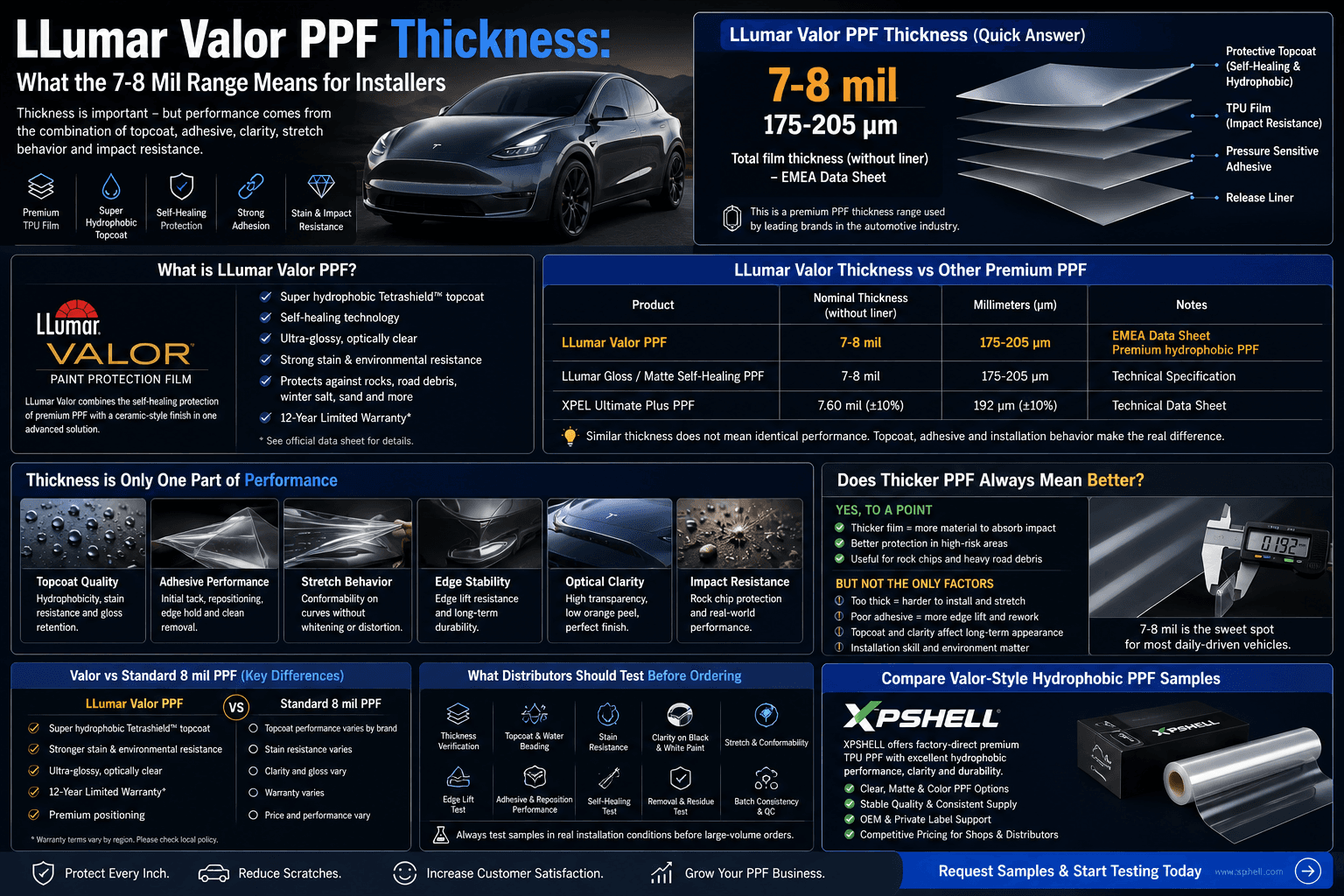
LLumar Valor PPF thickness is listed as 7-8 mil / 175-205 μm in the LLumar Valor EMEA data sheet [2]. That answer is useful, but it is not enough for installers.
For PPF shops and distributors, the bigger question is not only “how thick is LLumar Valor?” The better question is:
Does the film combine the right thickness, topcoat, adhesive, stretch behavior, edge stability, clarity and impact resistance for profitable real-world installation?
LLumar Valor is a strong premium PPF benchmark because it is positioned as a 2-in-1 paint protection film with ceramic-style surface benefits, self-healing protection and a super hydrophobic top coat [1]. But if a shop or distributor is comparing Valor with standard 8 mil PPF, XPEL-style PPF or factory-direct hydrophobic PPF samples, thickness should be treated as only one parameter in a larger testing process.
Quick answer: LLumar Valor PPF thickness
| Product | Thickness | What it means |
|---|---|---|
| LLumar Valor PPF | 7-8 mil / 175-205 μm | Premium PPF thickness range with hydrophobic top coat |
| LLumar self-healing gloss / matte PPF technical spec | 7-8 mil without liner or cap sheet | Standard premium PPF construction range |
| XPEL Ultimate Plus technical data sheet | 192 μm / 7.60 mil nominal thickness without release liner, ±10% | Similar market range, but different construction and adhesive system |
LLumar Valor is not positioned as “extra thick PPF.” It is better understood as a premium hydrophobic PPF where the topcoat story is as important as the thickness number.
What is LLumar Valor PPF?
LLumar Valor is a premium paint protection film that combines PPF protection with ceramic-style easy-clean surface behavior. LLumar describes Valor as giving the self-healing protection of premium PPF with a ceramic-style finish in a single product [1].
The official Valor material highlights:
| Feature | Valor positioning |
|---|---|
| Self-healing | Surface scratches can self-heal with heat |
| Topcoat | Super hydrophobic Tetrashield technology |
| Finish | Ultra-glossy, optically clear appearance |
| Stain resistance | Stronger resistance against acid rain, bird droppings and tree sap |
| Road protection | Protection against rocks, road debris, winter salt and sand |
| Warranty | 12-year manufacturer’s limited warranty in the official Valor page and EMEA data sheet |
| Thickness | 7-8 mil / 175-205 μm in the EMEA data sheet |
This makes Valor a premium benchmark for shops that want to sell high-end PPF packages, especially to customers who ask for easy cleaning, water beading, stain resistance and long-term finish quality.
LLumar Valor thickness range
The LLumar Valor EMEA data sheet lists the thickness range as 7-8 mil / 175-205 μm [2].
This means Valor sits in the common premium PPF thickness range used by many professional automotive paint protection films. In practical shop language:
| Measurement | Meaning |
|---|---|
| 7 mil | Around 177.8 μm |
| 8 mil | Around 203.2 μm |
| 175-205 μm | Roughly equal to the 7-8 mil range |
| Without liner? | Always check whether the spec includes or excludes release liner and cap sheet |
The last point matters. Some technical data sheets describe total film construction without the release liner, while others may show a layer diagram that includes liner thickness separately. When comparing two films, installers should confirm whether the thickness number includes only the installed film or includes packaging layers that are removed before installation.
Does thicker PPF always mean better protection?
No. Thicker PPF does not automatically mean better PPF.
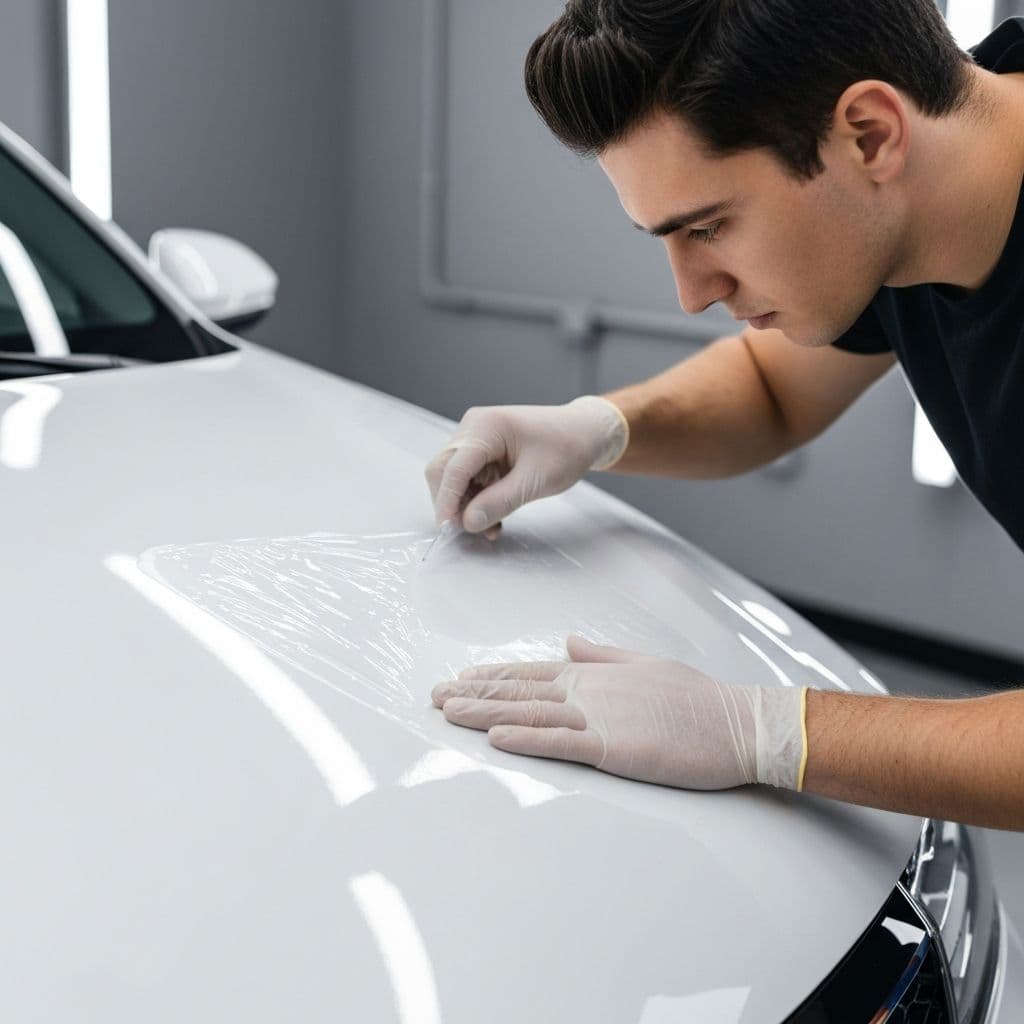
Thickness can help with impact absorption, especially in high-risk areas such as rocker panels, lower doors, bumpers and track-use vehicles. But a film that is thicker can also be harder to install if the adhesive, stretch behavior or topcoat flexibility is not well balanced.
For installers, the better question is:
| Question | Why it matters |
|---|---|
| Is the film thick enough for daily road impact? | Basic protection requirement |
| Does the topcoat resist stains and water spots? | Long-term appearance and customer satisfaction |
| Does the adhesive reposition cleanly? | Installation speed and lower rework |
| Does the film stretch without distortion? | Bumpers, mirrors and curved panels |
| Does the edge stay down after curing? | After-sales risk |
| Does the film remain optically clear? | Premium finish and customer trust |
| Does it resist yellowing and environmental damage? | Especially important for white vehicles |
| Is warranty support clear? | Risk control for shops and distributors |
A good 7-8 mil film with strong topcoat, stable adhesive and clean optical clarity can outperform a thicker film that is difficult to install or prone to edge lift.
Valor vs standard 8 mil PPF
Many installers compare LLumar Valor with “standard 8 mil PPF.” This comparison can be useful, but only if the shop defines what “standard” means.
| Comparison point | LLumar Valor PPF | Standard 8 mil PPF |
|---|---|---|
| Thickness | 7-8 mil / 175-205 μm | Usually around 7.5-8 mil, depending on supplier |
| Topcoat | Super hydrophobic Tetrashield ceramic-like top coat | Varies by supplier |
| Self-healing | Yes | Usually yes in premium-grade films |
| Stain resistance | Strong official positioning against stains and environmental hazards | Varies widely |
| Clarity | Marketed as ultra-glossy and free of orange peel-like texture | Depends on film quality |
| Adhesive behavior | Must be tested by installer | Varies widely |
| Warranty | 12-year limited warranty in Valor official materials | Depends on supplier |
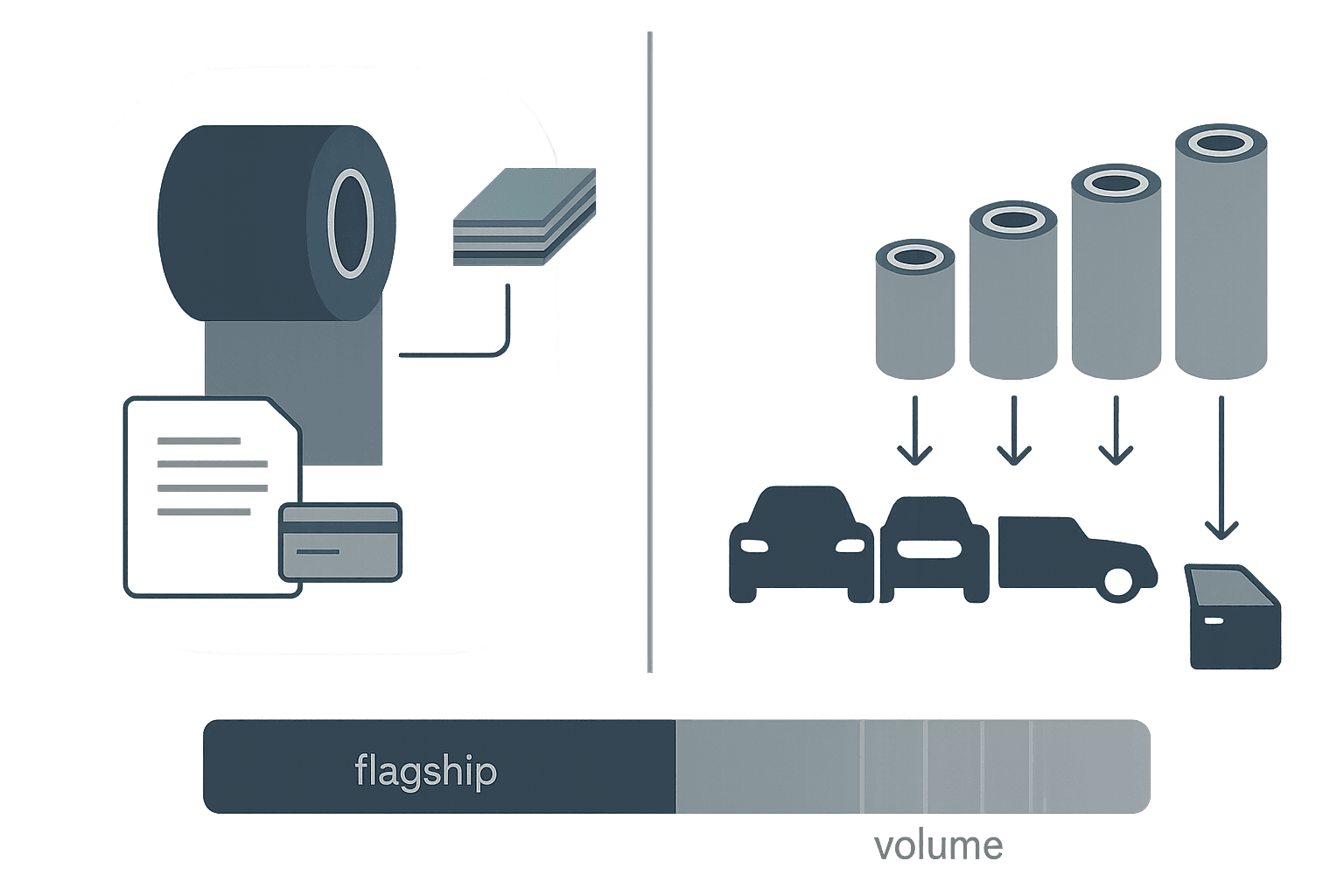
| B2B flexibility | Dealer/distributor structure | Factory-direct options may support private label and margin control |
The real difference is not simply that Valor is 7-8 mil. The difference is that Valor packages the thickness with premium topcoat technology, strong hydrophobic marketing, warranty support and brand trust.
For a factory-direct PPF supplier, this creates a useful benchmark. A Valor-style hydrophobic PPF alternative should not compete only on price. It should be tested against Valor-style expectations: gloss, water behavior, stain resistance, adhesive feel, edge stability and installation consistency.
LLumar Valor vs XPEL thickness
Installers also search for “LLumar Valor vs XPEL thickness” because XPEL is another common premium PPF benchmark.
The XPEL Ultimate Plus technical data sheet lists nominal thickness without release liner as 192 μm / 7.60 mil, ±10%. Its construction diagram shows clearcoat, polyurethane and acrylic adhesive layers, with the polyester release liner listed separately [4].
| Product | Thickness figure | Practical reading |
|---|---|---|
| LLumar Valor PPF | 7-8 mil / 175-205 μm | Premium hydrophobic PPF range |
| XPEL Ultimate Plus | 192 μm / 7.60 mil nominal without release liner, ±10% | Similar premium PPF range |
| Typical premium PPF | Around 7-8 mil | Thickness is comparable, so testing should go beyond thickness |
This comparison shows why shops should avoid oversimplifying the sales message. Valor and XPEL-style films are both in a similar premium thickness category. The better comparison is not “which one is thicker?” but:
- Which one installs faster?
- Which one has better clarity?
- Which one has better edge hold?
- Which one has stronger stain resistance?
- Which one has better hydrophobic behavior?
- Which one gives the shop better margin?
- Which one has more stable supply?
- Which one supports the shop’s customer positioning?
Thickness vs installability
Installability is where many PPF business decisions are won or lost.
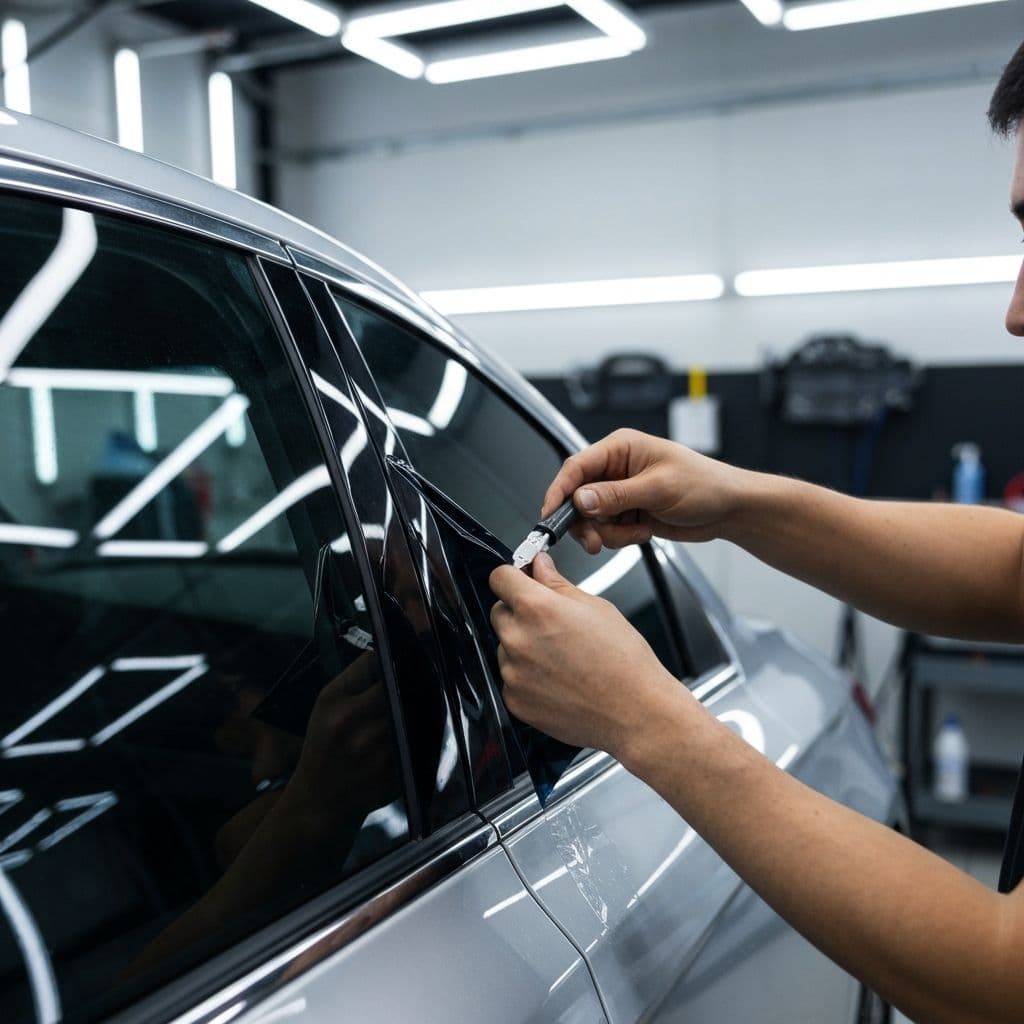
A film can look excellent in a data sheet but still create problems during real installation. For shops, installation behavior affects labor time, rework cost and customer satisfaction.
| Installation factor | What installers should test |
|---|---|
| Initial tack | Does the film grab too fast or too slowly? |
| Repositioning | Can the installer lift and reset without glue marks? |
| Stretch behavior | Does the film stretch smoothly on bumpers and mirrors? |
| Distortion | Does gloss or clarity change after stretching? |
| Edge hold | Do corners and edges stay down after curing? |
| Slip solution sensitivity | Does the film work consistently with normal shop solutions? |
| Topcoat durability | Does squeegee work leave marks or texture? |
| Adhesive residue | Does removal leave residue during testing? |
The LLumar Valor data sheet also gives application and storage guidance, including a recommended installation environment of 15.5°C-32°C and recommended storage conditions in the same temperature range [2]. That is another reminder that PPF performance is not only the film itself. Shop environment, storage and installation process also affect the final result.
Thickness vs topcoat
For modern PPF, the topcoat is often the difference between a customer being satisfied for years and a customer coming back with complaints.
A 7-8 mil film can perform very differently depending on the topcoat.
| Topcoat factor | Why it matters |
|---|---|
| Hydrophobicity | Makes the car easier to wash and improves customer-visible water behavior |
| Stain resistance | Helps resist bug residue, bird droppings, tree sap and road grime |
| Scratch recovery | Supports self-healing of light surface marks |
| Gloss retention | Keeps the installed film looking new |
| Chemical resistance | Helps resist cleaners and road contamination |
| Texture control | Reduces orange peel-like appearance and optical distortion |
Valor’s core value story is built heavily around topcoat. LLumar says Valor uses OEM-trusted Tetrashield technology, is super hydrophobic, reduces water and dirt buildup, and offers more stain-fighting power against acid rain, bird droppings and tree sap [1].
So if a distributor is comparing Valor-style samples, the first test should not be “is it 8 mil?” The first test should be: “Does the topcoat still look good after contamination, washing and installation stress?”
Thickness vs adhesive
Adhesive quality is less visible to the customer, but it is critical for installers.
A PPF shop should pay close attention to:
| Adhesive behavior | Why it matters |
|---|---|
| Balanced tack | Helps installers position the film correctly |
| Clean repositioning | Reduces glue marks and installation defects |
| Edge stability | Prevents lifting after delivery |
| Residue control | Reduces risk during removal |
| Compatibility | Works on common automotive paint systems |
| Curing behavior | Affects final appearance and after-sales risk |
A film with similar thickness but poor adhesive can cost the shop more money than it saves. Reinstalling a bumper, fixing lifting edges or handling complaints can destroy the profit from a cheaper roll.
Thickness vs impact resistance
PPF thickness does matter for impact resistance, but it must be read together with material construction.
The LLumar Valor data sheet lists rock chip resistance as “Pass” under SAE J400 / ASTM D3170 and gives the 7-8 mil thickness range [2]. The XPEL Ultimate Plus technical data sheet also lists stone chip resistance testing under ASTM D3170 / SAE J400 with no detrimental effect [4].
For shops, that means the correct comparison should include:
| Test item | Why it matters |
|---|---|
| Rock chip resistance | Shows impact defense against gravel-like road debris |
| Tensile strength | Indicates strength under pulling force |
| Elongation | Affects stretch and conformability |
| Tear resistance | Helps with durability during install and use |
| Weathering | Indicates long-term exposure resistance |
| Chemical resistance | Helps against cleaning and contamination |
| Stain resistance | Protects appearance after real-world use |
Thickness is the headline number. Impact resistance is the result the customer actually cares about.
What distributors should test before ordering
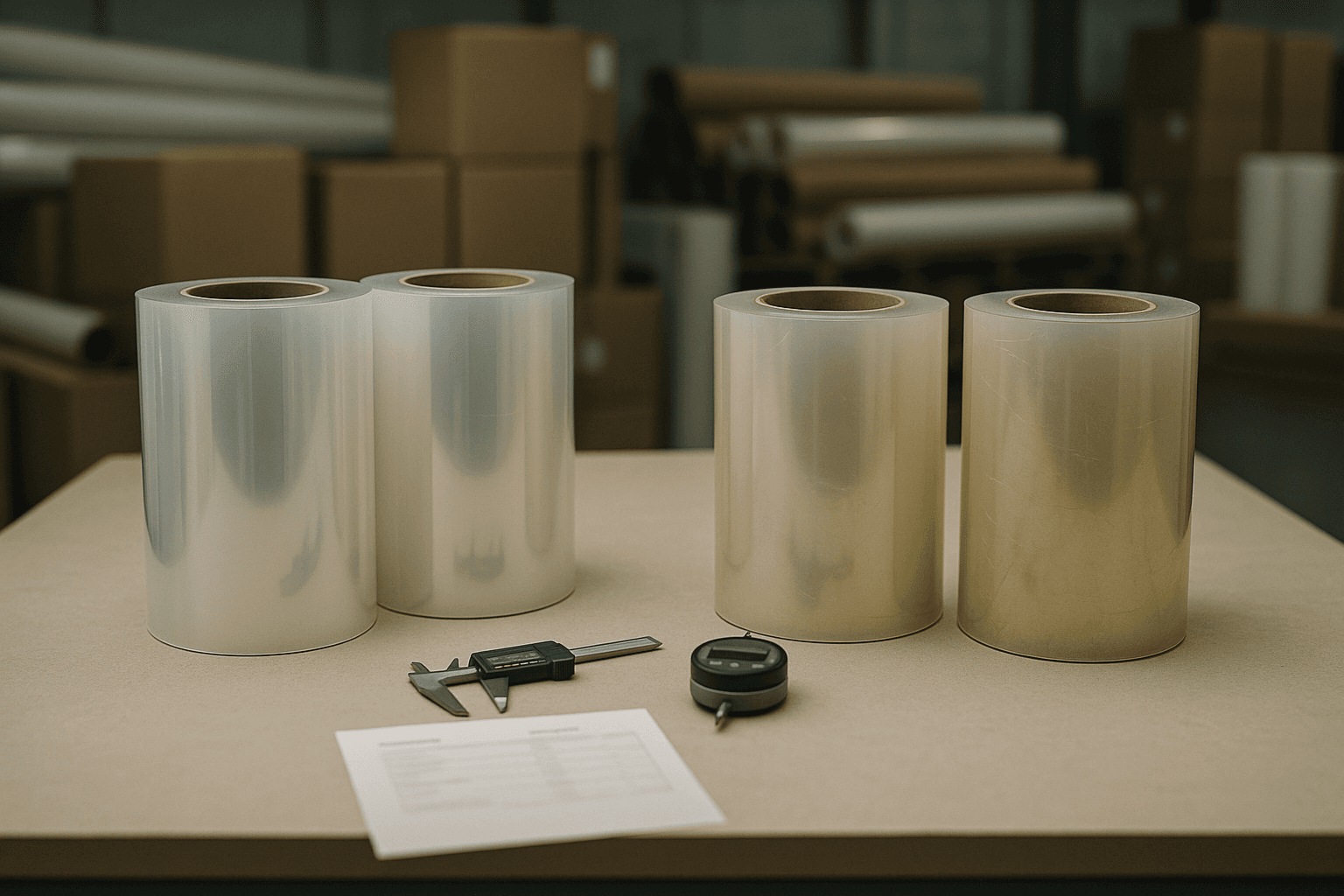
Distributors should not order based only on a data sheet. They should test the film the way their shop customers will use it.
| Test area | What to do | What to watch |
|---|---|---|
| Thickness check | Confirm installed film thickness, excluding liner | Make sure specs are comparable |
| Black panel clarity | Install on black paint | Haze, orange peel, distortion |
| White panel aging | Install on white paint | Yellowing, adhesive color shift |
| Hydrophobic test | Water beading and sheeting before and after washing | Topcoat durability |
| Stain test | Bug residue, bird dropping simulation, tar cleaner, road grime | Staining or topcoat failure |
| Stretch test | Apply on bumper corner or mirror | Whitening, distortion, adhesive marks |
| Edge test | Wrap edges and check after 48-72 hours | Edge lift or bubbles |
| Heat recovery | Create light surface marks and apply heat | Self-healing response |
| Removal test | Remove test piece after curing | Residue, paint safety |
| Batch consistency | Test more than one roll or batch | Quality stability |
This is especially important for distributors selling to professional installers. Installers will quickly notice if a film is inconsistent from roll to roll.
How shops should explain LLumar Valor thickness to customers
Customers may ask: “How thick is LLumar Valor PPF?”
A clear answer is:
LLumar Valor PPF is listed as 7-8 mil / 175-205 μm in the official EMEA data sheet. That is a premium PPF thickness range. But the reason shops sell Valor is not only thickness. Valor also combines self-healing protection, a super hydrophobic topcoat, high gloss, stain resistance and a 12-year limited warranty in official materials.
Then the shop can add:
For daily driving, 7-8 mil is a common premium PPF range. For high-impact areas like rocker panels or track-use vehicles, some customers may consider thicker or specialized films. For most daily drivers, film quality, installer skill and coverage area matter more than chasing the thickest number.
How XPSHELL should position a Valor-style hydrophobic PPF alternative
XPSHELL should not position itself as “cheap Valor.” That weakens the page.
A better positioning is:
XPSHELL offers factory-direct hydrophobic PPF samples for shops and distributors that want to compare Valor-style performance while improving margin, private label flexibility and supply control.
| Buyer need | XPSHELL angle |
|---|---|
| Compare Valor-style samples | Provide hydrophobic clear PPF samples |
| Improve margin | Factory-direct supply structure |
| Build private label | OEM packaging and distributor support |
| Reduce supply risk | Stable roll supply for shops |
| Test before ordering | Sample rolls and panel testing |
| Expand product mix | Clear, matte, color and high-impact options |
The message should be: compare, test and build a profitable product line - not simply “buy cheaper film.”
Recommended internal links
Use this page as a precise specification support page inside the PPF brand comparison cluster:
- Link “LLumar Valor vs Platinum PPF” to your Valor vs Platinum comparison page.
- Link “Tesla Model Y PPF” to your Tesla Model Y PPF Guide.
- Link “PPF thickness” to your general Paint Protection Film Product page.
- Link “factory-direct PPF” to your PPF Wholesale / Distributor page.
- Link “hydrophobic PPF samples” to your XPSHELL sample request or product testing page.
- Link “XPEL alternative” to your XPEL PPF for Tesla Model Y Alternatives page.
FAQ
What is LLumar Valor PPF thickness?
LLumar Valor PPF thickness is listed as 7-8 mil / 175-205 μm in the LLumar Valor EMEA data sheet.
What does 7-8 mil PPF mean?
A mil is one-thousandth of an inch. In PPF, 7-8 mil is a common premium film thickness range. It usually refers to the installed film construction, but buyers should always check whether the data sheet includes or excludes the release liner.
Is LLumar Valor thicker than standard PPF?
Not necessarily. LLumar Valor sits in the common premium 7-8 mil PPF range. Its main difference is not only thickness, but also its super hydrophobic Tetrashield topcoat, self-healing behavior, stain resistance and premium warranty positioning.
Is thicker PPF always better?
No. Thicker PPF can help with impact resistance, but it may also be harder to install if the film is not well balanced. Installers should also compare clarity, adhesive, stretch behavior, edge hold, stain resistance and topcoat durability.
How does LLumar Valor thickness compare with XPEL?
LLumar Valor is listed as 7-8 mil / 175-205 μm. XPEL Ultimate Plus technical data lists nominal thickness without release liner as 192 μm / 7.60 mil, ±10%. They are broadly in a similar premium PPF thickness category, so shops should compare performance and installability, not only thickness.
What should installers test besides thickness?
Installers should test optical clarity, orange peel, hydrophobicity, stain resistance, adhesive tack, repositioning, stretch behavior, edge lift, self-healing, removal behavior and batch consistency.
What should distributors test before ordering Valor-style hydrophobic PPF?
Distributors should test sample rolls on black and white panels, curved bumper areas, rocker panels and high-contact surfaces. They should also test water behavior, stain resistance, edge hold, removal residue and consistency across batches.
Can XPSHELL provide Valor-style hydrophobic PPF samples?
XPSHELL can support shops and distributors with factory-direct hydrophobic PPF samples, wholesale rolls, OEM packaging and private label support. The goal is to help B2B buyers compare film performance before building a full product line.
CTA
Want to compare Valor-style hydrophobic PPF samples before ordering rolls?
XPSHELL supplies factory-direct paint protection film for installers, PPF shops and distributors. Request clear gloss, matte or color PPF samples to test thickness, topcoat performance, adhesive behavior, stretch, clarity, stain resistance and edge stability.
Build your PPF product line based on real installation testing - not thickness numbers alone.
References
[1] LLumar Valor Paint Protection Film(https://llumar.com/en/paint-protection-film/valor/)
[2] LLumar Valor Paint Protection Film EMEA Data Sheet(https://irp.cdn-website.com/bfd19572/files/uploaded/LL_EMEA_23_PPF_Valor_Datasheet_EN_Screen.pdf)
[3] LLumar Paint Protection Film Gloss / Matte Technical Specification(https://www.manprint-sign.nl/wp-content/uploads/2022/11/LLumar-PPF-Gloss-Matt.pdf)
[4] XPEL Ultimate Plus Technical Data Sheet(https://www.xpel.com/web-assets/downloads/XPEL-ULTIMATE-PLUS-TDS-82019-V1-1.pdf)
[5] XPSHELL Paint Protection Film Product Page(https://xpshell.com/paint-protection-film)
[6] XPSHELL PPF Wholesale / Distributor Page(https://xpshell.com/ppf-wholesale)